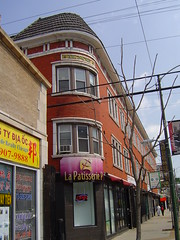
My particular little corner of Uptown is known as Argyle Park, although few people actually use that name anymore. Nowadays, it's called Little Saigon or New Chinatown. But this is what it looked like a hundred years ago:
I think we're looking north from Argyle, but I'm not entirely certain.
From Wikipedia:
The West Argyle Street Historic District (also known as New Chinatown, Little Saigon, or Little Vietnam) is a historic district in the Uptown community area of Chicago, Illinois. It was listed on the National Register of Historic Places on June 3, 2010. The district covers an area of about 41 acres (0.17 km2); its rough boundaries are Broadway to the west, Winona Street to the north, Sheridan Road to the east, and Ainslie Street to the south.
The area covered by the historic district originally developed in the 1880s as a suburb called Argyle Park. The suburb had been named by Chicago Alderman and developer James A. Campbell for his ancestors the Dukes of Argyll in Scotland. Development was centered around a station on the new Chicago & Evanston line of the Chicago, Milwaukee, and St. Paul Railway that opened in May 1885. The village, along with the rest of the Lake View Township, was annexed into Chicago in 1889.
In 1908 the Northwestern Elevated Railroad was extended north from Wilson Avenue, using the tracks of the Chicago, Milwaukee, & St. Paul Railroad. This linked the suburb into Chicago's 'L' network, and the area became popular with people of limited means who wanted to live on the Lake Michigan shore. The railroad tracks were elevated onto an embankment between 1914 and 1922.
Showing posts with label Argyle. Show all posts
July 21, 2013
June 28, 2013
Vintage Ad Essanay Studios, Argyle St., Chicago
A terrific vintage ad for Essanay Studios, including the address for the studio at 1333 Argyle in the Uptown Neighborhood. Original can be purchased on eBay at http://bit.ly/13cWpDR
Backlot of Essanay Studios, Uptown, Chicago
Currently on eBay is this photograph from the backlot of Essanay Studios; original available here: http://bit.ly/13cVRh4 Clicking the image will also take you there.
August 29, 2011
Mickey's Miracle Cabaret, Argyle St., Uptown Chicago 1956
Note the advertisement for "Ossie Osborne" and his trio! This image ran in a Chicago paper following a triple murder at 1114 Argyle. We featured an earlier photo of the same tavern from 1946, which ran after a shootout. (See that one here: Mickey's)
Labels:
Argyle
July 22, 2011
May 25, 2011
March 3, 2011
Super High-Resolution of Argyle Street
We just learned a nifty trick for uploading the high-resolution images of the IDOT collection, so I'll spend some time in the next few days updating all the IDOT posts with close ups. Here's one image of Argyle. Click to enlarge (and click again), and you can practically see inside people's windows.
Labels:
Argyle
March 1, 2011
Sheridan and Argyle, Uptown Chicago 1936
Holy cow! My condo is at Argyle and Winthrop — this first image blows my mind. It's the only photo I've seen of the Argmore Theater. The street looks nothing like this today.
Detail:
From the IDOT collection. Below: Looking down Sheridan from Argyle, toward the Edgewater Beach Hotel, which is on the right side of the street just north of Foster.
Source: Illinois Department of Transportation Chicago Traffic photographs
Collection: IDOT Chicago Traffic Photographs (University of Illinois at Chicago)
Repository: Special Collections and University Archives, University of Illinois at Chicago Library
Detail:
From the IDOT collection. Below: Looking down Sheridan from Argyle, toward the Edgewater Beach Hotel, which is on the right side of the street just north of Foster.
Source: Illinois Department of Transportation Chicago Traffic photographs
Collection: IDOT Chicago Traffic Photographs (University of Illinois at Chicago)
Repository: Special Collections and University Archives, University of Illinois at Chicago Library
November 16, 2010
Jimmy Wong, Uptown Entrepreneur, 1964
While perusing eBay's treasures today, I found this photo of Jimmy Wong. From seller's caption: "Jimmy Wong, Pat Stevens studio model, Ondine, and Del Clark of WRSV FM 98.3 Skokie, Illinois. Del was interviewing restaurateur Jimmy Wong in one of his restaurants at 3058 W. Peterson, December 22, 1964. Jimmy Wong's restaurants were often called "the most publicized" in Chicago, but Jimmy Wong, entrepreneur and host, was more than a media-savvy businessman."
According to Wikipedia: "Chicago restaurateur Jimmy Wong bought property in the [Uptown] area in the 1960s and planned its rebirth as New Chinatown. He envisioned a mall with pagodas, trees and reflecting ponds to replace the empty storefronts. The Hip Sing Association, a Chinese cultural group, moved its Chicago offices to Argyle street in 1971, and by 1974 Wong and the Hip Sing Association owned 80% of the three-block stretch on Argyle. Wong had an accident and broke both hips, leaving him unable to follow through on his plans. In 1979 Charlie Soo, founder of the Asian American Small Business Association, took up the cause, and the area developed not solely as a Chinese enclave but also including Vietnamese, Laotian, Cambodian, and Japanese businesses."
The original image is currently available here: Jimmy Wong, 1964
You can also see Jimmy Wong, along with Ald. Volini and Charlie Soo, in the 1960-1980 portal of the Roots of Argyle Mural.
To read more about the Argyle Mural, go here: Roots of Argyle.
"The entire Uptown community is grateful for his contribution," said Ald. Mary Ann Smith (48th). "He was the first one and, for a long time, the only one to have faith that good things could be established here. Because he set down roots here, eventually others followed. He reached out to a whole generation of new immigrants and helped them build their lives here."
According to Wikipedia: "Chicago restaurateur Jimmy Wong bought property in the [Uptown] area in the 1960s and planned its rebirth as New Chinatown. He envisioned a mall with pagodas, trees and reflecting ponds to replace the empty storefronts. The Hip Sing Association, a Chinese cultural group, moved its Chicago offices to Argyle street in 1971, and by 1974 Wong and the Hip Sing Association owned 80% of the three-block stretch on Argyle. Wong had an accident and broke both hips, leaving him unable to follow through on his plans. In 1979 Charlie Soo, founder of the Asian American Small Business Association, took up the cause, and the area developed not solely as a Chinese enclave but also including Vietnamese, Laotian, Cambodian, and Japanese businesses."
The original image is currently available here: Jimmy Wong, 1964
You can also see Jimmy Wong, along with Ald. Volini and Charlie Soo, in the 1960-1980 portal of the Roots of Argyle Mural.
To read more about the Argyle Mural, go here: Roots of Argyle.
"The entire Uptown community is grateful for his contribution," said Ald. Mary Ann Smith (48th). "He was the first one and, for a long time, the only one to have faith that good things could be established here. Because he set down roots here, eventually others followed. He reached out to a whole generation of new immigrants and helped them build their lives here."
Labels:
Argyle,
Jimmy Wong
November 15, 2010
Description of Argyle Park, 1893
My condo is near Argyle and Winthrop, in an area once known as Argyle Park. Here is an early description from John J. Flinn's book Chicago, the marvelous city of the West: a history, an enyclopedia, and a guide
, originally published in 1893.
Argyle Park. Situated on the Evanstpn division of the Chicago, Milwaukee & St. Paul R. R., five and a half miles from the City Hall. The history of Argyle Park dates back but a few years. W. C. Goudy owned the land upon which it stands, and to develop it he procured the construction of the railroad. Upon the completion of the road he conceived the idea of building an ideal suburban town. With this end in view he laid out the streets and avenues of generous proportions, platted the ground into lots 50x150 feet, built a depot, macadamized the streets, put in stone curbings and laid concrete sidewalks. To provide a water supply he had the town connected with the Lake View water system. For lighting purposes the town was connected with the gas works. The sanitary conditions of the town are perfect,
there being a double system of sewerage, one to the north and one to the south. Building restrictions and all the little details that go to make the whole perfect have been attended to. A regular force of men is employed to keep the streets in repair, to remove the garbage and to clean the snow from the sidewalks in winter. The Sheridan drive has done wonders for the town as well as for all the North Shore. Many of the residents of Argyle Park never use the steam cars as a means of transportation. A much more charming mode of getting to and from their places of business is a drive of thirty minutes along the incomparable Sheridan road and through matchless Lincoln Park.
Argyle Park. Situated on the Evanstpn division of the Chicago, Milwaukee & St. Paul R. R., five and a half miles from the City Hall. The history of Argyle Park dates back but a few years. W. C. Goudy owned the land upon which it stands, and to develop it he procured the construction of the railroad. Upon the completion of the road he conceived the idea of building an ideal suburban town. With this end in view he laid out the streets and avenues of generous proportions, platted the ground into lots 50x150 feet, built a depot, macadamized the streets, put in stone curbings and laid concrete sidewalks. To provide a water supply he had the town connected with the Lake View water system. For lighting purposes the town was connected with the gas works. The sanitary conditions of the town are perfect,
there being a double system of sewerage, one to the north and one to the south. Building restrictions and all the little details that go to make the whole perfect have been attended to. A regular force of men is employed to keep the streets in repair, to remove the garbage and to clean the snow from the sidewalks in winter. The Sheridan drive has done wonders for the town as well as for all the North Shore. Many of the residents of Argyle Park never use the steam cars as a means of transportation. A much more charming mode of getting to and from their places of business is a drive of thirty minutes along the incomparable Sheridan road and through matchless Lincoln Park.
Labels:
Argyle,
Argyle Park
November 4, 2010
Hotel Somerset, Dorset Hotel (4943 Sheridan), and Edgewater Beach Hotel, Sheridan and Argyle, Uptown Chicago 1964

A terrific view of Sheridan from 1964, which shows both the Somerset Hotel with the marquee still on top, and the Dorset. Way in the distance, you can see the Edgewater Beach Hotel and apartments.
Labels:
Argyle,
Dorset,
Edgewater Beach Hotel,
Sheridan,
Somerset
October 15, 2010
Double Door, 1126 Argyle, Uptown Chicago
Purchase original here: Double Door Manager
Caption reads: Nate Treger, tavern manager of The Double Door at 1126 Argyle Avenue, in Shakespeare Police Station on January 19, 1957. He was questioned by police about the Day murder investigation.
When researching the address to see what else might have been here besides the Double Door, I found a 1909 reference that the address was a delivery station of the Chicago Public Library. "The public library is free to all residents of the city. Books may be borrowed for home reading either at the main building downtown or at any of the various delivery stations. The only requirement is that the borrower must furnish a certificate signed by a property owner guaranteeing the library against loss. At the close of September, 1909, the public library contained 369,247 volumes. The aggregate circulation for the year ending May 31, 1909, was 1,777,142 volumes, which does not include the use of books kept on the open shelves at the main library or its branches or the periodicals or newspapers used in the reading rooms."
Today, the address is one of two locations for QIdeas, where you can buy serving ware at wholesale prices..
Labels:
Argyle
Celebrating the Statehood of Hawaii in Uptown Chicago, Argyle and Broadway, 1959
Purchase the original here: Hawaii Statehood
From seller's caption: Bob Boyajian, June Siegel and Mort Archer, employees of the Combined Insurance Company of America, celebrating Hawaii's statehood in front of their building in Chicago, at 5050 N. Broadway, March 13, 1959. Next door, barber John Schmidt watches from his storefront window.
October 3, 2010
Argyle Street, Uptown Chicago, 1946
Photos of Argyle Street are hard to come by, so I was particularly delighted to see this one. It shows Mickey's Tavern at 1114 Argyle, scene of a shootout in 1946.
Click image for larger view with seller, or go directly here: 1114 Argyle, 1946
Labels:
Argyle
September 6, 2010
Lion Dancers, Uptown Chicago, 2005
Lion Dancers, Uptown, Chicago, 2005. Photo by Henry Dombey/FACECOLLECTIVE and republished here with permission.
From Wikipedia. A lion dance is a form of traditional dance in Chinese culture, in which performers mimic a lion's movements in a lion costume. The lion dance is often mistaken as a dragon dance. An easy way to tell the difference is that a lion is operated by two people, while a dragon needs many people. Also, in a lion dance, the performers' faces are covered, since they are inside the lion. In a dragon dance, the performers can be seen since the dragon is held upon poles. Basic lion dance fundamental movements can be found in most Chinese martial arts.
Lion Dance on Chinese New Year and Festivals
During the Chinese New Year, lion dancer troupes from the Chinese martial art schools or Chinese guild and associations will visit the houses and shops of the Chinese community to perform the traditional custom of "cai ching", literally means "plucking the greens", a quest by the lion to pluck and eat the auspicious greens, normally vegetables like lettuce, which in Chinese is called 'cái' and sounds like 'cái' (fortune), and auspicious fruit like oranges, tied to a "Red Envelope" containing money; they are either hung highly or put on a table in front of the premises. The lion dance is believed to bring good luck and fortune to the business and the troupe is rewarded with the "red envelope".
The lion dance is sometimes performed at other traditional, cultural and religious festivals, business opening events, birthday celebrations, and wedding ceremonies.
In the old days, the lettuce was hung 15 to 20 feet above ground and only a well-trained martial artist could reach the money while dancing with a heavy lion head. These events became a public challenge. A large sum of money was rewarded, and the audience expected a good show. Sometimes, if lions from multiple martial arts schools approached the lettuce at the same time, the lions are supposed to fight to decide a winner. The lions had to fight with stylistic lion moves instead of chaotic street fighting styles. The audience would judge the quality of the martial art schools according to how the lions fought. Since the schools' reputation was at stake, the fights were usually fierce but civilized. The winning lion would then use creative methods and martial art skills to reach the high-hanging reward.
Some lions may dance on bamboo stilts and some may step on human pyramids formed by fellow students of the school. The performers and the schools would gain praise and respect on top of the large monetary reward when they did well. Nowadays, performances to attain the red envelope are not as rigorous, but lion dance troupes still have the onus of making a good show or face the consequence of an unhappy client.
During the 1950s-60s, in some areas with high population of Chinese and Asian communities, especially the Chinatown in many foreign countries around in the world, people who joined lion dance troupes were “gangster-like” and there was a lot of fighting amongst lion dance troupes and kung fu schools. Parents were afraid to let their children join lion dance troupes because of the “gangster” association with the members. During festivals and performances, when lion dance troupes met, there would be fights between groups. Some lifts and acrobatic tricks are designed for the lion to “fight” and knock over other rival lions. Performers even hid daggers in their shoes and clothes, which could be used to injure other lion dancers’ legs, or even attached a metal horn on their lion’s forehead, which could be used to slash other lion heads. The violence got so extreme that at one point, the Hong Kong government had to put a stop to lion dances completely.
Now, as with many other countries, lion dance troupes must attain a permit from the government in order to perform lion dance. Although there is still a certain degree of competitiveness, troupes are a lot less violent and aggressive. Today, lion dance is a more sport-oriented activity. Lion dance is more for recreation than a way of living. But there are still plenty of troupes who still practice the traditional ways and taboos of the lion dance as it is practiced in the past.
Labels:
Argyle
June 15, 2010
Uptown Argyle Street Named to Historic Register
Uptown's Argyle Street Named To Historic Register
On June 3, the West Argyle Street Historic District – bounded by Sheridan Road on the east, Ainslie Street on the south, Broadway on the west, and Winona Street on the north – was listed on the national register...
Read more about it here.
(My own condo, pictured here if you're looking to rent, rent to own, or buy, falls within this area.)
Buildings In Vibrant Southeast Asian District Reflected Bustling Community In Early 20th Century
The buildings that make up a vibrant section of the Uptown neighborhood known for its Southeast Asian dining and culture have landed the area on the National Register of Historic Places.
On June 3, the West Argyle Street Historic District – bounded by Sheridan Road on the east, Ainslie Street on the south, Broadway on the west, and Winona Street on the north – was listed on the national register...
Read more about it here.
(My own condo, pictured here if you're looking to rent, rent to own, or buy, falls within this area.)
Labels:
Argyle
February 28, 2010
June 27, 2009
Argmore Building on Argyle at Kenmore
You've probably walked past it before, but did you know the Argmore building was once a theatre? Here is the info from CinemaTreatures.org:
"The Argmore was opened in 1913, and two years later, was acquired from its original independent operator by the Alfred Hamburbger circuit. It was located... near the intersection of Argyle Street and Kenmore Avenue, hence the theater's name. In 1922, the Gumbiner Brothers took over operation of the Argmore. Acquired by the Essaness circuit in the 30s, it continued to be operated by that chain until closing in the early 1950s."
The Argmore was later converted to retail use. It currently houses La Patisserie P, Foremost Liquors, and other businesses. Click on image for larger view at Flickr.
"The Argmore was opened in 1913, and two years later, was acquired from its original independent operator by the Alfred Hamburbger circuit. It was located... near the intersection of Argyle Street and Kenmore Avenue, hence the theater's name. In 1922, the Gumbiner Brothers took over operation of the Argmore. Acquired by the Essaness circuit in the 30s, it continued to be operated by that chain until closing in the early 1950s."
The Argmore was later converted to retail use. It currently houses La Patisserie P, Foremost Liquors, and other businesses. Click on image for larger view at Flickr.
May 9, 2009
Hotel Somerset Advertisement, Argyle and Sheridan, Uptown Chicago

Here's a little more love for the Hotel Somerset this evening: a 1922 advertisement from Scribner's Magazine, volume LXXI, 1922. Text reads:
In Chicago's chief boulevard, near the lake, in the smart North Shore district, the luxurious new Somerset is the preferred abode of motor tourists and of others who seek highest class accommodations at moderate cost.
Kitchenette apartments (large and small) for families or single guests; also rooms, single or in suite, without kitchenettes; excellent restaurants, roof garden, solarium for parties and conventions. Spring and summer reservations now being received. For booklet and floor plans, address Hotel Somerset, Sheridan Road at Argyle, Chicago. S. W. Gerstner, Manager (formerly of French Lick Springs Hotel)
May 8, 2009
Somerset Hotel, circa 1964
And speaking of the Somerset, here's an image from the 1960s. It's currently available on eBay, item number 170329817768. I wonder when those gorgeous apartment buildings beside it were torn down.
Subscribe to:
Posts (Atom)