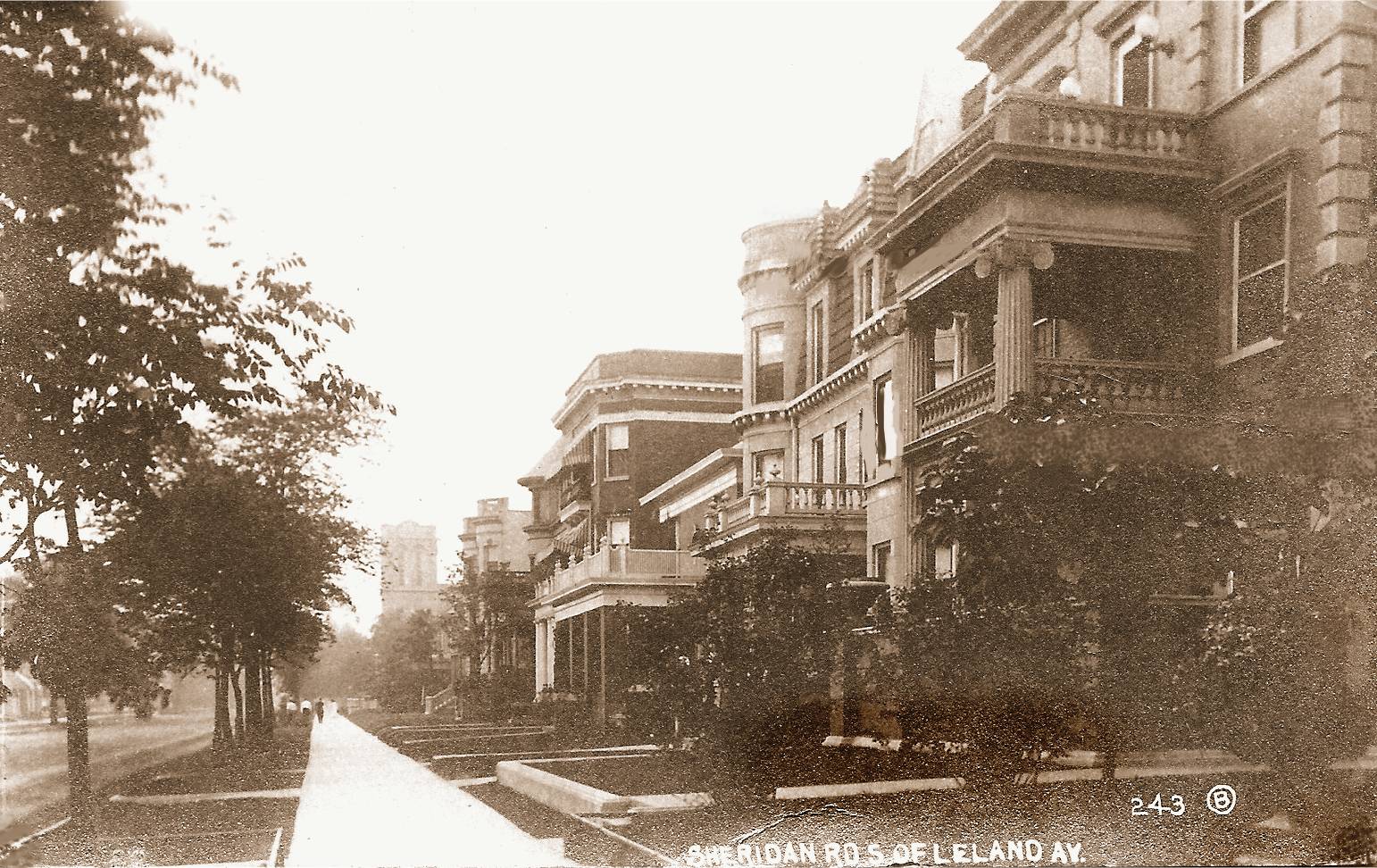
Showing posts with label Sheridan. Show all posts

Thursday, May 15, 2008

Letter from a Former Uptown Resident

I get a lot of readers, but I don't always hear a lot of feedback on this little ol' history blog, so e-mails like this just make my day:

I really love the website that you have created, I’m a product of uptown, I lived there from the late 1950’s until 1970 and the moved back for 2 years in 1975. Your website has brought back many memories, I went to school at Stewart, then transferred to Brenamen on Clarendon & Montrose and from there I was sent to Catholic school at St. Thomas of Canterbury on Kenmore and Lawrence. I had my first paper route delivering the American on Winthrop from Lawrence to Argyle in 1962. We use to go to the Lakeside theater on Saturdays and see three movies for a quarter, and the Uptown theater was the coolest, you get lost in that place and it was so fabulous inside, I remember a section that was hard to find that was all enclosed in glass and was located in between the upper balcony and the lower balcony all the seats were blue velour with polished brass it was definitely made for the elite. I spent many days at the Robert R. McCormick Boys Club on Sheridan and Gunnison what a great place for a boy to stay out of trouble. I can’t think of many places in uptown that I didn’t see as me and my brother wandered the streets all summer. Well I could go on forever about the great life I had there, so keep up the good work and if you ever have any questions about uptown I would love to share. -- R.C.

Thanks for reading, R.C.!

And what's your favorite memory of Uptown? Write me at blog(a)compassrose.com and I'll feature it here!

Tuesday, April 15, 2008

Sheridan Trust Lobby

Here's an interior scene of the lobby of the Sheridan Trust Bank when it was located in what is now the Borders Building. For an image of the exterior, go to the Cafe Press shop.

Saturday, April 5, 2008

St. Mary's of the Lake, Sheridan and Buena

Image courtesy John C.

Sheridan Sunnyside Service Station, 4501-4507 Sheridan, 1926

An advertising postcard from Sheridan Sunnyside Service Station, 4501-4507 Sheridan, 1926. Love their advertising slogan: "So much depends on proper lubrication and greasing." Indeed.

Wednesday, April 2, 2008

My Family's Connection to John Dillinger

Okay, it isn't a strong connection. After John Dillinger was shot outside the Biograph Theatre, my great Uncle Otto--who had been born in Poland but came to the U.S. with his parents-- hopped on his motorcycle to follow the body to the morgue, where crowds of thrill seekers filed past to get a look at the famed gangster. As far as I know, he was not one of those who dipped his handkerchief in Dillinger's blood as a souvenir.

Today's Trib has an article on Dillinger's Haunts, which include several locations in Uptown. The funeral home where he was embalmed is at 4506 N. Sheridan, a gorgeous old building which still stands. It's worth checking out the article, which includes an interactive map.

Thursday, March 6, 2008

Hotel Grasmere, 4621 N. Sheridan

The four-story Hotel Grasmere was designed by R.C. Harris and built in 1915. It survived as an apartment hotel well into the sixties. Today, the building is home to Grasmere Place, LLC. The image below is from Google maps.


Monday, February 25, 2008

Somerset Hotel, 5009 Sheridan at Argyle

The Somerset Hotel, on Sheridan at Argyle, looking north. What a great image! I wish the terracotta buildings just to the south were still there, instead of the mid-rise.


This is how the hotel looks today. Now known as Somerset Place, it functions as a nursing care facility. Image from Google street views.

The Somerset was designed by Samuel N. Crowen and opened in 1920. It originally had 441 furnished rooms arranged in 205 suites of one to four rooms. It was described as "the ideal dwelling place for those desiring the homelike atmosphere and privacy of an apartment combined with all the modern conveniences of a hotel." Jazz Age Chicago has an excellent history of the hotel.

Tuesday, November 27, 2007

Flapper Girls at Wilson and Sheridan, Nirvana by Ben Hecht


Flapper girls had their origins in the 1920s with the popular contempt for prohibition. The term referred to the “new breed” of young women who wore short skirts, bobbed their hair, listened to jazz, and flaunted their disdain for what was considered decent behavior. The flappers were seen as brash in their time for wearing makeup, drinking hard liqour, and smoking. This gorgeous painting of a flapper girl graced the cover of the February 2, 1922 edition of Life Magazine.

Novelist and prolific screenwriter Ben Hecht (1893–1964) grew up in Racine, Wisconsin. As a young man he moved to Chicago, where he became a reporter for the Chicago Journal and the Chicago Daily News and contributed to Margaret Anderson’s literary journal The Little Review. At the Daily News he wrote the sensational column “1001 Afternoons in Chicago,” where this short story about Uptown was first published (text courtesy Project Gutenberg). He later went on to write 35 books and more than seventy films.

***

The newspaper man felt a bit pensive. He sat in his bedroom frowning at his typewriter. About eight years ago he had decided to write a novel. Not that he had anything particular in his mind to write about. But the city was such a razzle-dazzle of dreams, tragedies, fantasies; such a crazy monotone of streets and windows that it filled the newspaper man’s thought from day to day with an irritating blur.

And for eight years or so the newspaper man had been fumbling around trying to get it down on paper. But no novel had grown out of the blur in his head.

* * * * *

The newspaper man put on his last year’s straw hat and went into the street, taking his pensiveness with him. Warm. Rows of arc lights. A shifting crowd. There are some streets that draw aimless feet. The blazing store fronts, clothes shops, candy shops, drug-stores, Victrola shops, movie theatres invite with the promise of a saturnalia in suspense.

At Wilson Avenue and Sheridan Road the newspaper man paused. Here the loneliness he had felt in his bedroom seemed to grow more acute. Not only his own aimlessness, but the aimlessness of the staring, smiling crowd afflicted him.

Then out of the babble of faces he heard his name called. A rouged young flapper, high heeled, short skirted and a jaunty green hat. One of the impudent little swaggering boulevard promenaders who talk like simpletons and dance like Salomes, who laugh like parrots and ogle like Pierettes. The birdlike strut of her silkened legs, the brazen lure of her stenciled child face, the lithe grimace of her adolescent body under the stiff coloring of her clothes were a part of the blur in the newspaper man’s mind.

She was one of the things he fumbled for on the typewriter—one of the city products born of the tinpan bacchanal of the cabarets. A sort of frontispiece for an Irving Berlin ballad. The caricature of savagery that danced to the caricature of music from the jazz bands. The newspaper man smiled. Looking at her he understood her. But she would not fit into the typewritten phrases.

“Wilson Avenue,” he thought, as he walked beside her chatter. “The wise, brazen little virgins who shimmy and toddle, but never pay the fiddler. She’s it. Selling her ankles for a glass of pop and her eyes for a fox trot. Unhuman little piece. A cross between a macaw and a marionette.”

* * * * *

Thus, the newspaper man thinking and the flapper flapping, they came together to a cabaret in the neighborhood. The orchestra filled the place with confetti of sound. Laughter, shouts, a leap of voices, blazing lights, perspiring waiters, faces and hats thrusting vivid stencils through the uncoiling tinsel of tobacco smoke.

On the dance floor bodies hugging, toddling, shimmying; faces fastened together; eyes glassy with incongruous ecstasies.

The newspaper man ordered two drinks of moonshine and let the scene blur before him like a colored picture puzzle out of focus. Above the music he heard the childishly strident voice of the flapper:

“Where you been hiding yourself? I thought you and I were cookies. Well, that’s the way with you Johns. But there’s enough to go around, you can bet. Say boy! I met the classiest John the other evening in front of the Hopper. Did he have class, boy! You know there are some of these fancy Johns who look like they were the class. But are they? Ask me. Nix. And don’t I give them the berries, quick? Say, I don’t let any John get moldy on me. Soon as I see they’re heading for a dumb time I say ’razzberry.’ And off your little sugar toddles.”

“How old are you?” inquired the newspaper man abstractedly.

“Eighteen, nosey. Why the insult? I got a new job yesterday with the telephone company. That makes my sixth job this year. Tell me that ain’t going good? One of the Johns I met in front of the Edgewater steered me to it. He turned out kind of moldy, and say! he was dumb. But I played along and got the job.

“Say, I bet you never noticed my swell kicks.” The flapper thrust forth her legs and twirled her feet. “Classy, eh? They go with the lid pretty nice. Say, you’re kind of dumb yourself. You’ve got moldy since I saw you last.”

“How’d you remember my name?” inquired the newspaper man.

“Oh, there are some Johns who tip over the oil can right from the start. And you never forget them. Nobody could forget you, handsome. Never no more, never. What do you say to another shot of hootch? The stuff’s getting rottener and rottener, don’t you think? Come on, swallow. Here’s how. Oh, ain’t we got fun!”

* * * * *

The orchestra paused. It resumed. The crowd thickened. Shouts, laughter, swaying bodies. A tinkle of glassware, snort of trombones, whang of banjos. The newspaper man looked on and listened through a film.

The brazen patter of his young friend rippled on. A growing gamin coarseness in her talk with a nervous, restless twitter underneath. Her dark child eyes, perverse under their touch of black paint, swung eagerly through the crowd. Her talk of Johns, of dumb times and moldy times, of classy times and classy memories varied only slightly. She liked dancing and amusement parks. Automobile riding not so good. And besides you had to be careful. There were some Johns who thought it cute to play caveman. Yes, she’d had a lot of close times, but they wouldn’t get her. Never, no, never no more. Anyway, not while there was music and dancing and a whoop-de-da-da in the amusement parks.

The newspaper man, listening, thought, “An infant gone mad with her dolls. Or no, vice has lost its humanness. She’s the symbol of new sin—the unhuman, passionless whirligig of baby girls and baby boys through the cabarets.”

* * * * *

They came back from a dance and continued to sit. The din was still mounting. Entertainers fighting against the racket. Music fighting against the racket. Bored men and women finally achieving a bedlam and forgetting themselves in the artifice of confusion.

The newspaper man looking at his young friend saw her taking it in. There was something he had been trying to fathom about her during her breathless chattering. She talked, danced, whirled, laughed, let loose giggling cries. And yet her eyes, the part that the rouge pot or the bead stick couldn’t reach, seemed to grow deader and deader.

The jazz band let out the crash of a new melody. The voices of the crowd rose in an “ah-ah-ah.” Waiters were shoving fresh tables into the place, squeezing fresh arrivals around them.

The flapper had paused in her breathless rigmarole of Johns and memories. Leaning forward suddenly she cried into the newspaper man’s ear above the racket:

“Say this is a dumb place.”

The newspaper man smiled.

“Ain’t it, though?” she went on. There was a pause and then the breathless voice sighed. She spoke.

“Gee!”—with a laugh that still seemed breathless—“gee, but it’s lonely here!”

Sunday, October 28, 2007

4152 Sheridan

Image Courtesy HAARGIS.

This beautiful mansion was located at 4152 Sheridan Rd. It was once the Coombs (Rowland) Funeral Home, and in the 1940s it was purchased by St. Mary's for use as a parish clubhouse. The first parish carnival was held on the grounds. What's located there today? You guessed it, condos. The below image was captured from Google street views. You can see the top of the tower at St. Mary's at the far upper right.


Tuesday, October 23, 2007

Montrose East of Sheridan

Tuesday, October 16, 2007

Polynesian Village / Edgewater Beach Hotel

Polynesian Villiage /The Edgewater Beach Hotel. Polynesian and Cantonese Food and Drink in a Setting of Tropical Splendor.

Thursday, October 11, 2007

Sheridan Road South from Lawrence, the Old Kemper Building


Does the old Kemper Building look strange to you? That's because it's actually shorter in this image than it is now. Four more stories were added some time after its initial construction.

It was built by Harry Emmerman in 1925 and housed the Mutual Insurance company. It was one of Uptown's best and most modern office buildings, with air conditioning and stunning views of Lake Michigan (the shore was closer in those days). In 1928, Kemper insurance moved into the top floors, and eventually bought and took over the building. It would be its headquarters for forty years, until the company moved out to Long Grove. They donated the building to Chicago Ecumenical Institute in 1971. Today, it houses a variety of non-profit groups.

I have a personal connection to this building (one generation removed). When my mom was young and single, she worked for Kemper Insurance. This was in the mid-sixties. She became good friends with two women who also worked there, Marsha and Herma. (Herma is now my godmother.)

When Marsha got engaged, she had a bridal shower, and my mom attended. Someone there took home movies, which Marsha later subjected her youngest brother Ron to. Being a good brother, he humored her, but he made her stop the film and back it up when this pretty blonde—my mom—appeared on the screen. "Who is that? Can you fix me up with her?" he asked.

Marsha went to work the following day, and told my mom what happened. "You don't have to go out with the guy if you don't want to, Donna," she said. "He is my brother." But my mom was game, and agreed to the blind date. A week later they were engaged.

And that's how my parents met.

Sunday, October 7, 2007

4365 Sheridan Chicago


This deco-looking building was located at Montrose and Sheridan, where the parking lot of the Jewel is now located. It housed several small businesses, including Top This Italian Beef, and a 30-lane bowling alley. At the far right, you can see the Buena Memorial Presbyterian Church.

Image courtesy HAARGIS.

Sunday, September 23, 2007

Sheridan Road and Evanston Avenue (Broadway)


A few days ago, I posted an image of the intersection of Sheridan/Montrose/Broadway. Here is another view, taken from further back, showing the same building. I don't have an exact date for it.

At one time, Broadway Avenue (off to the left in this image) was named Evanston Avenue because it went, well, up to Evanston. Sheridan Road goes off to the right in this photo.

Saturday, September 22, 2007

Costume from the Edgewater Beach Hotel

I found this sketch a few years back, and one of these days I'll get around to framing it. Until then, I'll share it here.

It's a design sketch for a costume used in one of the floor shows at the Edgewater Beach Hotel. Every month would bring a new floor show featuring top national acts from across the country and a line of dancers. Through the ’40s and ’50s, the Dorothy Hild Dancers performed there, and I imagine it was designed for her dancers. You gotta love the bird hat!

The only identity as to the artist is the signature "Marilyn." The costume was to fit nine girls for the "Snowbird Ballet."

Friday, September 21, 2007

Montrose, Sheridan, Broadway


Many thanks to my friend Andy for finding this terrific historic postcard, postmarked 1910. With all the other rehabs going on in the neighborhood, wouldn't it be great to replicate the original ornamentation at the top of this building?

Tuesday, September 18, 2007

Scrap Metal Drive, Buena Park Uptown, 1942

I found this WWII series of photos one day while digging through the Library of Congress archives. They show a group of children from Block 8 Zone 2 donating scrap metal and other materials to the war effort. Block 8 Zone 2 was bordered by Sheridan, Montrose, Broadway, and Sunnyside.

The first image showing the little girl is captioned: "Jaqueline Halloran, 4424 North Sheridan Road, bringing in a load of tin cans for scrap to her block Office of Civilian Defense headquarters, 1942. Her father was a switchman on a railroad in Chicago." None of the other photos are labeled with the names of individuals, just the event.

What I particularly like is the photo showing the names of men who lived in the district who were off fighting in the war. It would be nice to have something like that in Uptown now. I have no idea which of my neighbors are in Iraq.

Click each image for a larger view.

Related Books (this will take you to Amazon):

Daddy's Gone to War: The Second World War in the Lives of Children

Wartime America: The World War II Homefront


Friday, September 14, 2007

Sheridan Restaurant & Cocktail Lounge, Buena Park / Lake View Chicago


No postmark on this one, but I think it dates to the 1930s. Sheridan Restaurant & Cocktail lounge was located at 3944 N. Sheridan, under the L tracks, where "Sheridan L Liquors" is now.

Of course, a 1930s cocktail lounge image deserves another 1930s cocktail. This is also from the Savoy Cocktail Book book:

Jabberwock Cocktail

This will make you gyre and gimble in the wabe until brillig, all right, all right. (Green Fairy's Note: I have no idea what that means.)

2 dashes Orange Bitters
1/3 part Dry Gin
1/3 part Dry Sherry
1/3 part Caperitif (GF: A defunct mixer, but you can substitute with Lillet Blanc.)

Stir well and strain into cocktail glass. Squeeze lemon peel on top.

Wednesday, September 12, 2007

Buena Memorial Presbyterian Church, Buena Park, Uptown Chicago

When the roof of Buena Memorial Presbyterian Church collapsed in 1996, it was the beginning of the end. Years of neglect and deferred maintenance had taken their toll, and the century-or-so-old church was to be demolished.

Buena Memorial was located at 4247-4301 N. Sheridan Rd., near Montrose and Broadway, on that little peninsula-like piece of land where The Mark condos now stand.

Additional photos of the interior—including closeups of the collapsed roof—can be seen at King Richard's Religious Artifacts, the company responsible for the salvage operation. Fortunately, a great deal of the stained glass and other fixtures were saved.

A very depressing photo of the final destruction can be seen at Midwest Wrecking.

Sunday, September 9, 2007

Remembering the Edgewater Beach Hotel

Edgewater Beach Hotel Poster

1930s Uptown comes alive in Kerne Erickson’s painting of the Edgewater Beach Hotel, available as a poster. The Edgewater, originally located near Sheridan and Foster, lost its beautiful beach front when Lake Shore Drive was extended, and was eventually torn down in the late 1960s. Today, the 33-floor The Breakers of Edgewater Beach, a retirement home built in 1987, stands where the tower of the hotel once stood. Editor, author, playwright, and occasional film producer Adam Langer wrote an amazing tribute to the Edgewater. A link to the full article follows the excerpt below:

Remembering the Edgewater Beach Hotel

My parents spent their honeymoon there. My Aunt Faye and Uncle Harry had their high school prom there. They wanted to dance on the Beach Walk, but the 17-year cicadas were swarming, so they had to stay indoors in the Marine Dining Room. I don’t remember the place, but I do remember my dad driving us by in 1970 to watch it being demolished. We sat in the back of his black Thunderbird while he took home movies of the wrecking ball crashing into the [yellow] stucco structure...

For the rest of the article, go to Remembering the Edgewater Beach Hotel.