
Showing posts with label Wilson. Show all posts
Showing posts with label Wilson. Show all posts
July 20, 2013
Broadway North of Montrose, 1926 — Arcadia Ballroom, McJunkin Building
Here is a fantastic scene of Broadway just north of Montrose. You can see the exquisite blue and white terracotta building, torn down a few years ago, a rare view of the Arcadia Ballroom with Wilson Yards behind, the McJunkin building at Wilson just up the way, and far off in the distance the rooftop marquee of the recently completed Uptown Theatre. Thanks to reader Mike M. for sharing this one!


July 8, 2013
Hotel Sheridan Plaza, Wilson and Sheridan, Uptown Chicago

Text reads:
Uptown Chicago's Most Favored Hotel!
Why not this coming summer spend a few days or weeks on the famous North Shore—Chicago's vacation land? Come to the beautiful Sheridan Plaza. Bathing, boating, motoring, theater-going. Short ride to golf grounds and parks. Music and dancing every evening. Moderate rates in the restaurant and Narcissus Grill cafeteria. Eighteen minutes from downtown: elevated express and surface lines; motor busses to and from downtown through Lincoln Park stop at the door. European plan. Excellent rates with private bath. $3 a day and up. Reservations are advisable. Exceptional garage accommodation.
Image currently on eBay: http://bit.ly/183KQNy
July 6, 2013
Wilson Ave Bathing Beach, 1910

A very early image of Wilson Avenue Bathing Beach. Note that few people are actually wearing bathing costumes. Image currently available on eBay: http://bit.ly/12avXYH
July 1, 2013
Broadway Near Wilson, 1972

Two Chicago police officers and their 1972 Chevy Biscayne on Broadway near Wilson.
Wilson and Broadway, Uptown, 1970s

You can just make out the name "Goldblatts" on the water tower at right.
Wilson and Broadway, Uptown Chicago, 1959
A photo from when the terra cotta still looked good, although the clock was already gone. Image available on eBay: http://bit.ly/1d3xOA3


Muggsie McGraw Wonder Bar, Wilson Avenue, Uptown Chicago

Seems 935 Wilson housed a number of entertainment venues over the years; it was also once known as the Backstage Nightclub.
June 25, 2012
CTA Montrose at Wilson Yard, 1972

September 18, 2011

September 9, 2011
Electroliner at Wilson Avenue, Uptown Chicago, 1941
Thanks to Uptown Update for the head's up on this, a North Shore line Electroliner at Wilson Avenue in January 1941 (original
Kodachrome transparency photo by Charles E. Keevil from the Walter R. Keevil collection.


August 29, 2011
Accident at Wilson L, 1956
Currently on eBay there is a seller with images from an accident at the Wilson L station in 1956. Here is one of them (item 190571078950); in the background you can see the Yankee Grill, which I think was the on 1100 block of Wilson. Check out eBay to see the rest of this seller's items.


August 25, 2011
Wilson Avenue, 1970

Wilson Avenue, looking west. The Bank of Chicago in the image is the TCF Bank Building (formerly the Wilson Theatre). Image available on eBay: item 160639430714

August 18, 2011
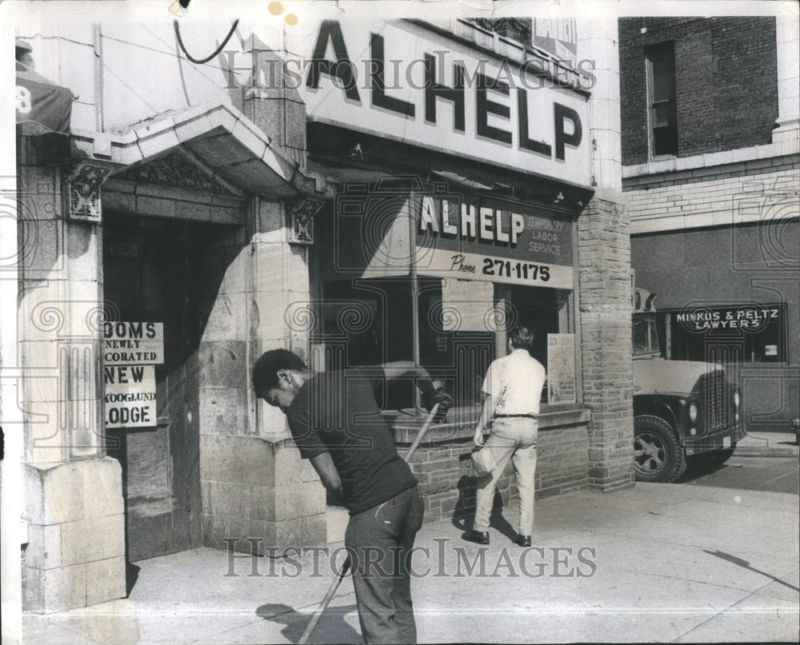
Day Labor Worker on Wilson Ave., Chicago, 1971
Currently available on eBay (item 150649693523) is this image of a man on Wilson, which originally ran in the Times in 1971.

Excerpt from the article:
There were long scratches on his neck and face. The upper lid of his right eye was swollen and bluish. He hadn't shaved for at least two days. Harold Pixler was sitting in the Wilson Ave. apartment house doorway staring into the street. His white shirt was black around the collar and cuffs. There was a rip in the left knee of his black pants. His shoes were falling apart. He was not wearing socks.
On the other side of the street, just west of the firehouse, three men were standing outside a tavern passing a wine bottle back and forth. None of them was dressed any better than Harold Pixler. A few doors down the street, lounging in front of a day-labor center, stood a black man with crutches and a cast on his left leg and a white man with his left arm heavily bandaged.
This is Uptown. When you come right down to it, this is what Uptown is all about for so many of the Appalachian whites, Indians, and Puerto Ricans who are trapped here. Their only hope for jobs is in the day labor pools that provide barely enough in salary to pay for room and board. The work is hard and uninteresting. But leisure time in the bars along Wilson Ave. isn't any more interesting.
They are all in a trap. They don't have the slightest chance of getting out, and you can tell by looking into their eyes that they know it...

Excerpt from the article:
There were long scratches on his neck and face. The upper lid of his right eye was swollen and bluish. He hadn't shaved for at least two days. Harold Pixler was sitting in the Wilson Ave. apartment house doorway staring into the street. His white shirt was black around the collar and cuffs. There was a rip in the left knee of his black pants. His shoes were falling apart. He was not wearing socks.
On the other side of the street, just west of the firehouse, three men were standing outside a tavern passing a wine bottle back and forth. None of them was dressed any better than Harold Pixler. A few doors down the street, lounging in front of a day-labor center, stood a black man with crutches and a cast on his left leg and a white man with his left arm heavily bandaged.
This is Uptown. When you come right down to it, this is what Uptown is all about for so many of the Appalachian whites, Indians, and Puerto Ricans who are trapped here. Their only hope for jobs is in the day labor pools that provide barely enough in salary to pay for room and board. The work is hard and uninteresting. But leisure time in the bars along Wilson Ave. isn't any more interesting.
They are all in a trap. They don't have the slightest chance of getting out, and you can tell by looking into their eyes that they know it...
August 10, 2011
Wilson Ave. with Deluxe Theatre, Uptown, 1971
A snippet of the old Deluxe Theatre, once located at 1141 Wilson, just west of Broadway, can be seen in this image from 1971. The original is currently on eBay: item 160635442932.


August 9, 2011
JOIN Office, Wilson and Sheridan, 1966
The exterior of the Jobs or Income Now (JOIN) office, 1966.

Image now available on eBay: item 290595622819.

Image now available on eBay: item 290595622819.
August 6, 2011

July 20, 2011
Crews Bringing Supplies to Wilson Avenue Crib, 1950

From Wikipedia:
Water cribs are offshore structures that collect water from close to the bottom of a lake to supply a pumping station onshore. The name crib is derived from the function of the structure—to surround and protect the intake shaft. Cities supplied with drinking water collected by water cribs include Chicago, Illinois; Cleveland, Ohio; and Buffalo, New York.
Cribs in Chicago, Illinois
The City of Chicago is supplied with drinking water from Lake Michigan. The first crib, the Two-Mile Crib was constructed as part of a scheme by Ellis S. Chesbrough in 1865. Water was collected and transported through a tunnel 60 feet below the lake surface to the Chicago Avenue pumping station. This was replaced by the Carter H. Harrison crib in 1900, which itself was intended to be replaced by the William E. Dever crib that was built alongside it in 1935. However increased water demand meant that the Carter H. Harrison crib continued in service until 1997.
Other cribs include the Wilson Avenue crib, the Four Mile Crib, and the 68th Street crib. The 68th Street crib was the site of a fire that killed 70 workmen on the morning of January 20, 1909. The tunnels leading from the cribs are close to 200 feet beneath the lake and vary in shape from circular to ovular and in diameter from 10 to 20 feet. Lake water enters the cribs and flows through these tunnels to pumps at the Jardine Water Purification Plant (the world's largest) and the South Water Purification Plant, where the water is then treated. From there it is pumped to all parts of the city as well as 118 suburbs.
Until the 1990s, Crib Tenders lived on the cribs. Usually four man crews stayed aboard the cribs for a week at a time. Their duties included water testing, light maintenance, and dynamiting ice dams that formed against the cribs' walls. Crib facilities included rudimentary bathrooms, showers, and bunk rooms—and a fantastic view of the city and lake.
The massive amount of polluted water that flows into the lake from Chicago is beginning to affect the water quality—even four miles off shore. The City of Chicago has proposed a plan involving the construction of new cribs twelve or fifteen miles farther north.
The Chicago cribs have also been designated a "security zone". In 2002 complete security systems were installed, including video, motion detectors, microwave link, and door sensors, all with direct links to Chicago Police monitoring stations. Any craft that enters the buoyed security zone is subject to boarding, ticketing and impounding.
Wilson Avenue Crib in 1957.

Images currently on eBay here: 230648282559, 260818343779

July 17, 2011
Subscribe to:
Posts (Atom)
LinkWithin

LinkWithin