| From the archive... The Uptown Theater. |
| Source: Chicago Evening Post, editorial, 19 August 1925, p. 12. |
|
Year by year new Chicagos appear. They are integral
parts of the old Chicago, just a little bit removed from the parent, but
closely tied to it by easy and quick means of approach. They are in
every way a part of the city's heart. These new Chicagos are in
appearance cities in themselves, and they have all those things which
make for business, pleasure, social intercourse and for a better and
greater Chicago generally.
An imposingly beautiful new theater, known as the Uptown Theatre was opened yesterday for the enjoyment of Chicagoans, at the corner of Broadway and Lawrence avenue. It is one of Balaban & Katz houses of entertainment. It is beautiful without garishness. For its architecture and its adornment the inspiration was Spanish. Chicago has 3,000,000 people within its borders. New Chicago and Old Chicago are one. The man on Madison street is no stranger to the man on Lawrence avenue, nor to the man on the boulevards south and west. Worthy theaters always will have their place in Chicago. |
May 27, 2013
The Uptown Theatre — "Beautiful without Garishness"

May 23, 2013
Interior of the Riviera Theatre, Broadway near Lawrence


Before it was a popular northside concert venue, the Riviera was a theatre in every sense of the word. From Cinema Treasures: Initially the Riviera was to have been operated by the Jones, Linick & Schaefer chain, which operated several Loop movie houses in the 10s and 20s such as the Orpheum, the Rialto, and the McVickers. However, the Riviera ended up becoming the second major theater of the Balaban & Katz circuit. ... Featuring movies accompanied by an orchestra, the Riviera also featured “high class” musical acts onstage. The theater mainly catered to the upper-middle class residents of the Uptown area, especially women. [It]continued to remain one of the neighborhood’s most popular movie houses for decades, even once the 4500-seat Uptown Theatre practically next door.
May 19, 2013
Riviera Indoor Golf Course 4845 Broadway, Uptown, circa 1930

I'd love to find an exterior photo of the signage for this golf course, so if you have an image, please let me know!
May 18, 2013
Vintage Admission Ticket and Decal from Arcadia Roller Rink, Uptown
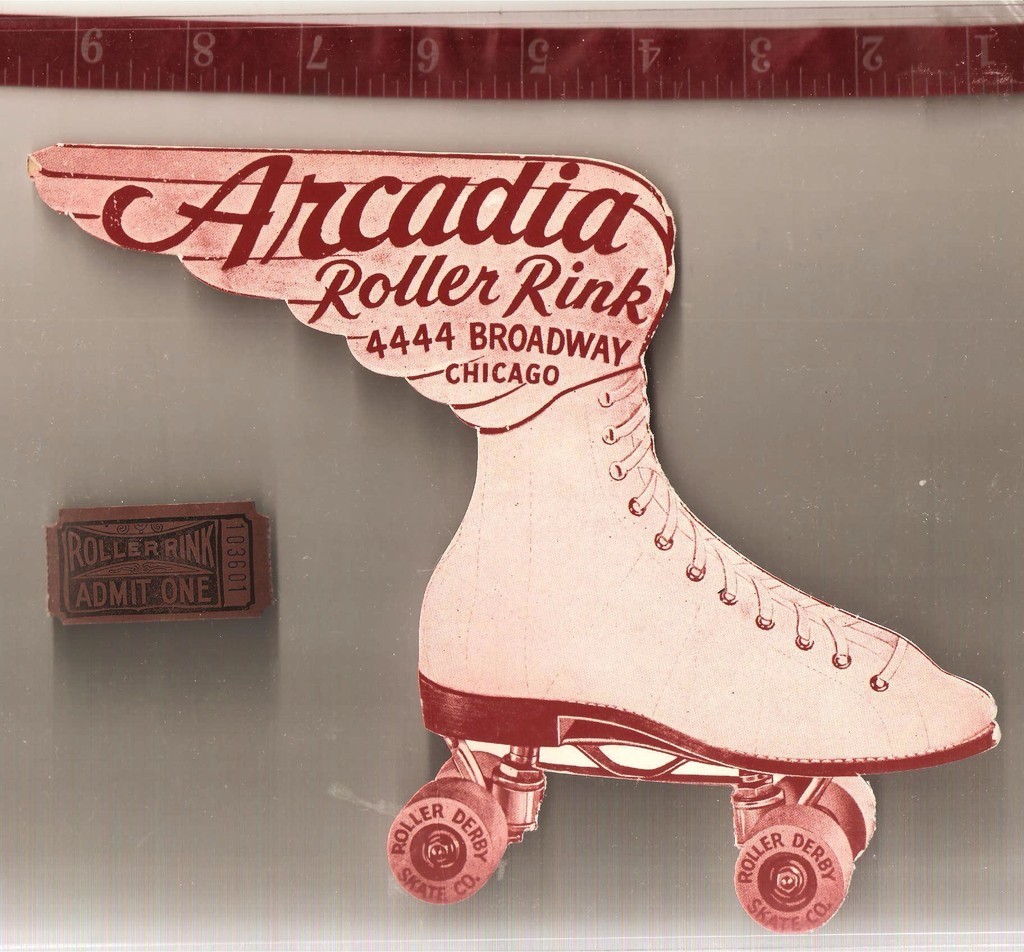
Here's another great eBay find we've added to the collection!
May 16, 2013
Mother and Baby, Wilson Beach, 1911

The more things change, the more they stay the same, or so the old saying goes. I enjoy looking at old photos like this, where people styles may have changed, but people are doing the same things they still do today...go to the beach, walk their babies, have a picnic. I'm sure that a hundred years from now, people will still be gathering at Uptown's shoreline to socialize and enjoy a fine summer's day.
May 13, 2013
We Love a Parade!
From the archive...
Uptown Chicago Pageant Festival of Fun and Color. Two Hundred Floats in Big Parade Tomorrow Evening.
Source: Chicago Evening Post, 19 August 1925, p. 6.
Gayly decorated streets and shop windows announced today to that part of Chicago between Montrose avenue, Argyle street, Racine avenue and the lake, that the pageant of 1925 being held by the Central Uptown Chicago association was in full swing.
The festivities, which began last night with the opening of the huge new Uptown Chicago movie theatre at Lawrence avenue and Broadway, will last until Saturday night. Tomorrow night will witness the "Parade of Color," in which 200 decorated floats will participate.
The "Central Uptown parade" will be held Friday night. The festivities will reach a climax Saturday night with a grand ball in Harmon's Arcadia. Motion picture, baseball and radio stars will be present.
Crowd at Theater.
After watching the crowds last night, J.R.S. Crowder, chairman of the pageant committee, estimated that at least half a million persons would "get acquainted" with the special advantages of the district for shopping and amusements.
More than 12,000 persons waited on either side of the Broadway entrance to the magnificent theater in an attempt to be members of the first audience. The seating capacity, however, was only 5,000. Several women collapsed in exhaustion.
500 Cops Assigned.
"Never have I witnessed an opening like it," said John Balaban of Balaban & Katz, the owners. "World's championship baseball games I have attended were tame affairs in comparison."
Five hundred policemen have been assigned to the line of march for tomorrow night's parade. North and south traffic will be halted while the event is in progress.
Uptown Chicago Pageant Festival of Fun and Color. Two Hundred Floats in Big Parade Tomorrow Evening.
Source: Chicago Evening Post, 19 August 1925, p. 6.
Gayly decorated streets and shop windows announced today to that part of Chicago between Montrose avenue, Argyle street, Racine avenue and the lake, that the pageant of 1925 being held by the Central Uptown Chicago association was in full swing.
The festivities, which began last night with the opening of the huge new Uptown Chicago movie theatre at Lawrence avenue and Broadway, will last until Saturday night. Tomorrow night will witness the "Parade of Color," in which 200 decorated floats will participate.
The "Central Uptown parade" will be held Friday night. The festivities will reach a climax Saturday night with a grand ball in Harmon's Arcadia. Motion picture, baseball and radio stars will be present.
Crowd at Theater.
After watching the crowds last night, J.R.S. Crowder, chairman of the pageant committee, estimated that at least half a million persons would "get acquainted" with the special advantages of the district for shopping and amusements.
More than 12,000 persons waited on either side of the Broadway entrance to the magnificent theater in an attempt to be members of the first audience. The seating capacity, however, was only 5,000. Several women collapsed in exhaustion.
500 Cops Assigned.
"Never have I witnessed an opening like it," said John Balaban of Balaban & Katz, the owners. "World's championship baseball games I have attended were tame affairs in comparison."
Five hundred policemen have been assigned to the line of march for tomorrow night's parade. North and south traffic will be halted while the event is in progress.
May 10, 2013
Creation of Montrose Point, 1936

Sandfilling and Breakwater Extension, Great Lakes, 1936. You can see the distinctive horse shoe at the end of the pier.
May 6, 2013
Are the Tickets All Sold?
From the archive...
Eager Throngs See New Theater Opening
Source: Chicago Evening American, 19 August 1925, pg. 9.
They keep coming and coming and coming.
The crowds forming at the doors of the new Balaban & Katz Uptown Theatre today threatened to equal the thousands that were on hand for the grand opening yesterday.
The Broadway and Lawrence av. district looked like a circus yesterday. A veritable standing army gathered before the doors of the magnificent moving picture palace and waited in the hot sun for several hours.
They were women for the most part and their gay Summer dresses formed a colorful parade, three blocks long. Street vendors sold balloons and refreshments.
Within the theater workmen were putting the finishing touches to the carpets, rearranging the vases and pictures for the last time. When the doors were opened the excitement in the street grew more intense, but those who entered the stately lobby filled with flowers became silent and spoke in whispers.
Toward the end of the line, several blocks away, the fans became anxious.
"Are the tickets all sold?" they asked anxiously. Even when the house had been filled to its capacity, the crowds still mobbed the streets.
Source: Chicago Evening American, 19 August 1925, pg. 9.
They keep coming and coming and coming.
The crowds forming at the doors of the new Balaban & Katz Uptown Theatre today threatened to equal the thousands that were on hand for the grand opening yesterday.
The Broadway and Lawrence av. district looked like a circus yesterday. A veritable standing army gathered before the doors of the magnificent moving picture palace and waited in the hot sun for several hours.
They were women for the most part and their gay Summer dresses formed a colorful parade, three blocks long. Street vendors sold balloons and refreshments.
Within the theater workmen were putting the finishing touches to the carpets, rearranging the vases and pictures for the last time. When the doors were opened the excitement in the street grew more intense, but those who entered the stately lobby filled with flowers became silent and spoke in whispers.
Toward the end of the line, several blocks away, the fans became anxious.
"Are the tickets all sold?" they asked anxiously. Even when the house had been filled to its capacity, the crowds still mobbed the streets.
May 2, 2013
Nirvana by Ben Hecht, 1921
A peek at Uptown through the eyes of author Ben Hecht...
The newspaper man felt a bit pensive. He sat in his bedroom frowning at his typewriter. About eight years ago he had decided to write a novel. Not that he had anything particular in his mind to write about. But the city was such a razzle-dazzle of dreams, tragedies, fantasies; such a crazy monotone of streets and windows that it filled the newspaper man’s thought from day to day with an irritating blur.
And for eight years or so the newspaper man had been fumbling around trying to get it down on paper. But no novel had grown out of the blur in his head.
* * * * *
The newspaper man put on his last year’s straw hat and went into the street, taking his pensiveness with him. Warm. Rows of arc lights. A shifting crowd. There are some streets that draw aimless feet. The blazing store fronts, clothes shops, candy shops, drug-stores, Victrola shops, movie theatres invite with the promise of a saturnalia in suspense.
At Wilson Avenue and Sheridan Road the newspaper man paused. Here the loneliness he had felt in his bedroom seemed to grow more acute. Not only his own aimlessness, but the aimlessness of the staring, smiling crowd afflicted him.
Then out of the babble of faces he heard his name called. A rouged young flapper, high heeled, short skirted and a jaunty green hat. One of the impudent little swaggering boulevard promenaders who talk like simpletons and dance like Salomes, who laugh like parrots and ogle like Pierettes. The birdlike strut of her silkened legs, the brazen lure of her stenciled child face, the lithe grimace of her adolescent body under the stiff coloring of her clothes were a part of the blur in the newspaper man’s mind.
She was one of the things he fumbled for on the typewriter—one of the city products born of the tinpan bacchanal of the cabarets. A sort of frontispiece for an Irving Berlin ballad. The caricature of savagery that danced to the caricature of music from the jazz bands. The newspaper man smiled. Looking at her he understood her. But she would not fit into the typewritten phrases.
“Wilson Avenue,” he thought, as he walked beside her chatter. “The wise, brazen little virgins who shimmy and toddle, but never pay the fiddler. She’s it. Selling her ankles for a glass of pop and her eyes for a fox trot. Unhuman little piece. A cross between a macaw and a marionette.”
* * * * *
Thus, the newspaper man thinking and the flapper flapping, they came together to a cabaret in the neighborhood. The orchestra filled the place with confetti of sound. Laughter, shouts, a leap of voices, blazing lights, perspiring waiters, faces and hats thrusting vivid stencils through the uncoiling tinsel of tobacco smoke.
On the dance floor bodies hugging, toddling, shimmying; faces fastened together; eyes glassy with incongruous ecstasies.
The newspaper man ordered two drinks of moonshine and let the scene blur before him like a colored picture puzzle out of focus. Above the music he heard the childishly strident voice of the flapper:
“Where you been hiding yourself? I thought you and I were cookies. Well, that’s the way with you Johns. But there’s enough to go around, you can bet. Say boy! I met the classiest John the other evening in front of the Hopper. Did he have class, boy! You know there are some of these fancy Johns who look like they were the class. But are they? Ask me. Nix. And don’t I give them the berries, quick? Say, I don’t let any John get moldy on me. Soon as I see they’re heading for a dumb time I say ’razzberry.’ And off your little sugar toddles.”
“How old are you?” inquired the newspaper man abstractedly.
“Eighteen, nosey. Why the insult? I got a new job yesterday with the telephone company. That makes my sixth job this year. Tell me that ain’t going good? One of the Johns I met in front of the Edgewater steered me to it. He turned out kind of moldy, and say! he was dumb. But I played along and got the job.
“Say, I bet you never noticed my swell kicks.” The flapper thrust forth her legs and twirled her feet.
“Classy, eh? They go with the lid pretty nice. Say, you’re kind of dumb yourself. You’ve got moldy since I saw you last.”
“How’d you remember my name?” inquired the newspaper man.
“Oh, there are some Johns who tip over the oil can right from the start. And you never forget them. Nobody could forget you, handsome. Never no more, never. What do you say to another shot of hootch? The stuff’s getting rottener and rottener, don’t you think? Come on, swallow. Here’s how. Oh, ain’t we got fun!”
* * * * *
The orchestra paused. It resumed. The crowd thickened. Shouts, laughter, swaying bodies. A tinkle of glassware, snort of trombones, whang of banjos. The newspaper man looked on and listened through a film.
The brazen patter of his young friend rippled on. A growing gamin coarseness in her talk with a nervous, restless twitter underneath. Her dark child eyes, perverse under their touch of black paint, swung eagerly through the crowd. Her talk of Johns, of dumb times and moldy times, of classy times and classy memories varied only slightly. She liked dancing and amusement parks. Automobile riding not so good. And besides you had to be careful. There were some Johns who thought it cute to play caveman. Yes, she’d had a lot of close times, but they wouldn’t get her. Never, no, never no more. Anyway, not while there was music and dancing and a whoop-de-da-da in the amusement parks.
The newspaper man, listening, thought, “An infant gone mad with her dolls. Or no, vice has lost its humanness. She’s the symbol of new sin—the unhuman, passionless whirligig of baby girls and baby boys through the cabarets.”
* * * * *
They came back from a dance and continued to sit. The din was still mounting. Entertainers fighting against the racket. Music fighting against the racket. Bored men and women finally achieving a bedlam and forgetting themselves in the artifice of confusion.
The newspaper man looking at his young friend saw her taking it in. There was something he had been trying to fathom about her during her breathless chattering. She talked, danced, whirled, laughed, let loose giggling cries. And yet her eyes, the part that the rouge pot or the bead stick couldn’t reach, seemed to grow deader and deader.
The jazz band let out the crash of a new melody. The voices of the crowd rose in an “ah-ah-ah.” Waiters were shoving fresh tables into the place, squeezing fresh arrivals around them.
The flapper had paused in her breathless rigmarole of Johns and memories. Leaning forward suddenly she cried into the newspaper man’s ear above the racket:
“Say this is a dumb place.”
The newspaper man smiled.
“Ain’t it, though?” she went on. There was a pause and then the breathless voice sighed. She spoke.
“Gee!”—with a laugh that still seemed breathless—“gee, but it’s lonely here!”
The newspaper man felt a bit pensive. He sat in his bedroom frowning at his typewriter. About eight years ago he had decided to write a novel. Not that he had anything particular in his mind to write about. But the city was such a razzle-dazzle of dreams, tragedies, fantasies; such a crazy monotone of streets and windows that it filled the newspaper man’s thought from day to day with an irritating blur.
And for eight years or so the newspaper man had been fumbling around trying to get it down on paper. But no novel had grown out of the blur in his head.
* * * * *
The newspaper man put on his last year’s straw hat and went into the street, taking his pensiveness with him. Warm. Rows of arc lights. A shifting crowd. There are some streets that draw aimless feet. The blazing store fronts, clothes shops, candy shops, drug-stores, Victrola shops, movie theatres invite with the promise of a saturnalia in suspense.
At Wilson Avenue and Sheridan Road the newspaper man paused. Here the loneliness he had felt in his bedroom seemed to grow more acute. Not only his own aimlessness, but the aimlessness of the staring, smiling crowd afflicted him.
Then out of the babble of faces he heard his name called. A rouged young flapper, high heeled, short skirted and a jaunty green hat. One of the impudent little swaggering boulevard promenaders who talk like simpletons and dance like Salomes, who laugh like parrots and ogle like Pierettes. The birdlike strut of her silkened legs, the brazen lure of her stenciled child face, the lithe grimace of her adolescent body under the stiff coloring of her clothes were a part of the blur in the newspaper man’s mind.
She was one of the things he fumbled for on the typewriter—one of the city products born of the tinpan bacchanal of the cabarets. A sort of frontispiece for an Irving Berlin ballad. The caricature of savagery that danced to the caricature of music from the jazz bands. The newspaper man smiled. Looking at her he understood her. But she would not fit into the typewritten phrases.
“Wilson Avenue,” he thought, as he walked beside her chatter. “The wise, brazen little virgins who shimmy and toddle, but never pay the fiddler. She’s it. Selling her ankles for a glass of pop and her eyes for a fox trot. Unhuman little piece. A cross between a macaw and a marionette.”
* * * * *
Thus, the newspaper man thinking and the flapper flapping, they came together to a cabaret in the neighborhood. The orchestra filled the place with confetti of sound. Laughter, shouts, a leap of voices, blazing lights, perspiring waiters, faces and hats thrusting vivid stencils through the uncoiling tinsel of tobacco smoke.
On the dance floor bodies hugging, toddling, shimmying; faces fastened together; eyes glassy with incongruous ecstasies.
The newspaper man ordered two drinks of moonshine and let the scene blur before him like a colored picture puzzle out of focus. Above the music he heard the childishly strident voice of the flapper:
“Where you been hiding yourself? I thought you and I were cookies. Well, that’s the way with you Johns. But there’s enough to go around, you can bet. Say boy! I met the classiest John the other evening in front of the Hopper. Did he have class, boy! You know there are some of these fancy Johns who look like they were the class. But are they? Ask me. Nix. And don’t I give them the berries, quick? Say, I don’t let any John get moldy on me. Soon as I see they’re heading for a dumb time I say ’razzberry.’ And off your little sugar toddles.”
“How old are you?” inquired the newspaper man abstractedly.
“Eighteen, nosey. Why the insult? I got a new job yesterday with the telephone company. That makes my sixth job this year. Tell me that ain’t going good? One of the Johns I met in front of the Edgewater steered me to it. He turned out kind of moldy, and say! he was dumb. But I played along and got the job.
“Say, I bet you never noticed my swell kicks.” The flapper thrust forth her legs and twirled her feet.
“Classy, eh? They go with the lid pretty nice. Say, you’re kind of dumb yourself. You’ve got moldy since I saw you last.”
“How’d you remember my name?” inquired the newspaper man.
“Oh, there are some Johns who tip over the oil can right from the start. And you never forget them. Nobody could forget you, handsome. Never no more, never. What do you say to another shot of hootch? The stuff’s getting rottener and rottener, don’t you think? Come on, swallow. Here’s how. Oh, ain’t we got fun!”
* * * * *
The orchestra paused. It resumed. The crowd thickened. Shouts, laughter, swaying bodies. A tinkle of glassware, snort of trombones, whang of banjos. The newspaper man looked on and listened through a film.
The brazen patter of his young friend rippled on. A growing gamin coarseness in her talk with a nervous, restless twitter underneath. Her dark child eyes, perverse under their touch of black paint, swung eagerly through the crowd. Her talk of Johns, of dumb times and moldy times, of classy times and classy memories varied only slightly. She liked dancing and amusement parks. Automobile riding not so good. And besides you had to be careful. There were some Johns who thought it cute to play caveman. Yes, she’d had a lot of close times, but they wouldn’t get her. Never, no, never no more. Anyway, not while there was music and dancing and a whoop-de-da-da in the amusement parks.
The newspaper man, listening, thought, “An infant gone mad with her dolls. Or no, vice has lost its humanness. She’s the symbol of new sin—the unhuman, passionless whirligig of baby girls and baby boys through the cabarets.”
* * * * *
They came back from a dance and continued to sit. The din was still mounting. Entertainers fighting against the racket. Music fighting against the racket. Bored men and women finally achieving a bedlam and forgetting themselves in the artifice of confusion.
The newspaper man looking at his young friend saw her taking it in. There was something he had been trying to fathom about her during her breathless chattering. She talked, danced, whirled, laughed, let loose giggling cries. And yet her eyes, the part that the rouge pot or the bead stick couldn’t reach, seemed to grow deader and deader.
The jazz band let out the crash of a new melody. The voices of the crowd rose in an “ah-ah-ah.” Waiters were shoving fresh tables into the place, squeezing fresh arrivals around them.
The flapper had paused in her breathless rigmarole of Johns and memories. Leaning forward suddenly she cried into the newspaper man’s ear above the racket:
“Say this is a dumb place.”
The newspaper man smiled.
“Ain’t it, though?” she went on. There was a pause and then the breathless voice sighed. She spoke.
“Gee!”—with a laugh that still seemed breathless—“gee, but it’s lonely here!”
Subscribe to:
Posts (Atom)
LinkWithin

LinkWithin