
August 31, 2010
Edgewater Apartments, seen from Edgewater Beach Hotel

August 29, 2010

Marigold Margarine Ghost Ad
Last week, we posted a photo of a ghost ad on Lincoln.
Uptown Chicago History reader Joel B. of Outdoor Impact sent us a photo of what the ad looked like in March 2007, before it was partially obscured by the new condo development next door.

Do you have photos of the Uptown area to share? E-mail them to editor(a)compassrose.org.
Uptown Chicago History reader Joel B. of Outdoor Impact sent us a photo of what the ad looked like in March 2007, before it was partially obscured by the new condo development next door.

Do you have photos of the Uptown area to share? E-mail them to editor(a)compassrose.org.
The Daniels Hotel, Winthrop, Uptown Chicago

Back in February, we posted a postcard of the Daniels Hotel, once located at 4718 Winthrop. We recently heard from the great-grandson of the original developer, who had this to say:
My great grandfather, Fred Owen Emery Daniels built it, but lost both the hotel and his other business, the Terminal Garage (located at 4464 N Broadway, Chicago), sometime in the Great Depression.
As far as the hotel on Winthrop Avenue, he sold bonds in order to finance the construction.
The bond is pictured above. You can see other images of the hotel, original advertisements, and news clippings about a murder that happened there, on Finnestad's blog: Emery / Daniels Ancestry
Green Mill Gardens Ceramic Bowl, Chicago, 1914

I have a few of these in my personal collection, already, so thought I'd give the head's up to someone else. There is a (spaghetti?) bowl currently listed on eBay that came from the Green Mill, located at Lawrence and Broadway. This nearly 100-year-old bit of tableware can be purchased here: 1914 Green Mill Gardens Plate
August 28, 2010
Aeriel Edgewater, Chicago, from North of Foster

Awesome shot from 1947; you can clearly see the Edgewater Beach Hotel and Edgewater Beach Apartments. Purchase from: Aeriel View Edgewater Beach Hotel
August 27, 2010
Balaban and Katz Uptown Theatre Featured in 1926 Article
Editor's Note: We were quite excited to win at auction a 1926 Chicago Engineering Works Review issue featuring the Uptown Theatre! The article focuses on the stage switchboard. Complete text from the article below. The Chicago Engineering Works school was located at 2150 Lawrence.


The orchestra leader swings his baton and the musicians glide into the opening strains of "Moonlight Sonata."
Far ahead a battery of flood lights is pouring down clear golden light upon them, but gradually the gold changes to soft blue and then to purple. Over the arched walls and domed ceiling a rosy glow begins to creep, brightening and darkening with the cadences and moods of the symphony. The perfect harmony of the music and the lighting holds the huge audiences spellbound.
"Aren't the lighting effects at the Uptown Theater marvelous?" comments every visitor to this great moving pictures palace. "Every part of the show has its own particular colorings—the lights seem to carry you along with the performance. I wonder how they do it?"
Many visiting C. E. W. students who have attended the Uptown Theater, just a mile east of the plant on Lawrence Avenue, have also wondered how these remarkable lighting effects were secured.
The picture on the cover of this Review gives you a glimpse of what goes on "back stage" at the Uptown to produce those fascinating lighting effects. Through the courtesy of Balaban & Katz, owners, and Mr. Burnstine, Chief Electrician of the Uptown, members of the C. E. W. staff were permitted to inspect the electrical equipment and particularly the stage switchboard, which is the largest of its kind in the world. The equipment used is the Major System, remote control, preselective type, made by the Frank Adam Electric Co., St. Louis, Mo.
The Uptown's switchboard is a truly beautiful piece of electrical installation. Built of sectional steel, the board is 28 feet long and cost $1,000 a foot, or a total of $28,000 to construct. It contains 1056 separate controls and during a single performance, over 450 k.w. will pass through the board. Two electricians are constantly at work, operating the controls in accordance with a carefully worked out program.
Three banks of controls, shown in the picture, operate amber (yellow), red and blue lights, the colors being indicated by bull's-eye lights on the board and by colored knob on the controls. There are six master levers at the center of the board for dimming or brightening whole groups of lights, while the big wheel shown in the foreground operatres as many controls as may be selected. An automatic telephone on the board gives instant communication with any part of the theater.
The switches on the stage switchboard operate the lights through remote control, the current passing from this board to a duplicate board in the basement vault, containing the clapper magnets and contacts. The purpose of this is to save space and remove all noise from the stage, as the clapper magnets make considerable sound when closing or opening. There is also some arcing, and locating the second board in the basement removes the fire hazard.
A multitude of wires connects the stage and basement boards with the feed line and lights, the three-wire system, carrying 110 volts, being used throughout. The wires are so systematically and neatly arranged that any circuit can be traced out in a few minutes' time.
Two huge electric signs on the front of the theater, each containing close to 1,000 lights; thousands of other lights outlining the theater building and in the lobbies and rest rooms, as well as the current required for projectors, spotlights, and electric air-cooling machinery, bring the peak load at the Uptown up to 1100 k.w.—enough electricity to supply a good-sized town!


The orchestra leader swings his baton and the musicians glide into the opening strains of "Moonlight Sonata."
Far ahead a battery of flood lights is pouring down clear golden light upon them, but gradually the gold changes to soft blue and then to purple. Over the arched walls and domed ceiling a rosy glow begins to creep, brightening and darkening with the cadences and moods of the symphony. The perfect harmony of the music and the lighting holds the huge audiences spellbound.
"Aren't the lighting effects at the Uptown Theater marvelous?" comments every visitor to this great moving pictures palace. "Every part of the show has its own particular colorings—the lights seem to carry you along with the performance. I wonder how they do it?"
Many visiting C. E. W. students who have attended the Uptown Theater, just a mile east of the plant on Lawrence Avenue, have also wondered how these remarkable lighting effects were secured.
The picture on the cover of this Review gives you a glimpse of what goes on "back stage" at the Uptown to produce those fascinating lighting effects. Through the courtesy of Balaban & Katz, owners, and Mr. Burnstine, Chief Electrician of the Uptown, members of the C. E. W. staff were permitted to inspect the electrical equipment and particularly the stage switchboard, which is the largest of its kind in the world. The equipment used is the Major System, remote control, preselective type, made by the Frank Adam Electric Co., St. Louis, Mo.
The Uptown's switchboard is a truly beautiful piece of electrical installation. Built of sectional steel, the board is 28 feet long and cost $1,000 a foot, or a total of $28,000 to construct. It contains 1056 separate controls and during a single performance, over 450 k.w. will pass through the board. Two electricians are constantly at work, operating the controls in accordance with a carefully worked out program.
Three banks of controls, shown in the picture, operate amber (yellow), red and blue lights, the colors being indicated by bull's-eye lights on the board and by colored knob on the controls. There are six master levers at the center of the board for dimming or brightening whole groups of lights, while the big wheel shown in the foreground operatres as many controls as may be selected. An automatic telephone on the board gives instant communication with any part of the theater.
The switches on the stage switchboard operate the lights through remote control, the current passing from this board to a duplicate board in the basement vault, containing the clapper magnets and contacts. The purpose of this is to save space and remove all noise from the stage, as the clapper magnets make considerable sound when closing or opening. There is also some arcing, and locating the second board in the basement removes the fire hazard.
A multitude of wires connects the stage and basement boards with the feed line and lights, the three-wire system, carrying 110 volts, being used throughout. The wires are so systematically and neatly arranged that any circuit can be traced out in a few minutes' time.
Two huge electric signs on the front of the theater, each containing close to 1,000 lights; thousands of other lights outlining the theater building and in the lobbies and rest rooms, as well as the current required for projectors, spotlights, and electric air-cooling machinery, bring the peak load at the Uptown up to 1100 k.w.—enough electricity to supply a good-sized town!
August 25, 2010
Eagle Food Center, 6009 Broadway, Edgewater, Chicago, 1958

A huge crowd waiting to get inside the new Eagle Food Center at its grand opening, October 15, 1958, in Chicago at 6009 N. Broadway in Edgewater. Today, the location is a Dominick's.
Eagle Food Centers was a chain of supermarkets, founded in 1893 by the Tenenbom family, that operated in Iowa, Wisconsin, and Illinois for a number of years. The company was based out of Milan, Illinois, which is near the Quad Cities of Illinois and Iowa. The company operated stores under many names, including BOGO'S, Eagle Country Market, Eagle Discount Centers, Eagle Discount Supermarkets, Eagle Food Centers, May's Drug and MEMCO.
Eventually, the company found that it was unable to compete with other chains, such as Jewel-Osco, Dominick's, Hy-Vee, Wal-Mart and Kroger. The first sign of this was the selling of the Harvest Day bakery plant in Rock Island, Illinois to the Metz Baking Company in 1998. The company went into Chapter 11 bankruptcy in March 2000. In 2003, Eagle Food Stores ceased operations, and sold off its assets. Some of the stores were acquired by other chains, such as Hy-Vee, Kroger, Albertsons, and Butera.
Purchase original image and reproduction prints here: Eagle Foods Grand Opening, 1958
The Vietnamese in Uptown
By the mid-1980s, Uptown had become home to 10,000 Indochinese immigrants. Author Nghia M. Vo covers some of that history in Vietnamese Boat People, 1954 and 1975-1992 . Here is a brief excerpt:
Read about how the Vietnamese popular transformed Uptown for the better in Vietnamese Boat People, 1954 and 1975-1992
. Here is a brief excerpt:Uptown Chicago was a fashionable area between 1900 and 1920. Germans, Swedes, and Irish moved in succession into the area, but in the '50s, Uptown gradually declined because its population slowly moved away. Multiple attempts to improve the area structurally and financially failed. Many organizations, including Chinese who wanted to build a second Chinatown, pushed developers to restore the buildings. Despite these restorations, there were no takers. The area remained "a ghost town after dark...dominated by pimps, prostitutes, and drug pushers who assembled on unlit, crumbling sidewalks." By 1980, 48 percent of the residents lived below the poverty line, compared to 37 percent for the city as a whole. What Uptown needed was an infusion of a large population willing to live and work in a district with a bad reputation and visible signs of decay. The local government solved the problem by inserting the newly arrived refugees in the low rent Uptown area. Having no preconceived ideas and nowhere else to go, the newcomers settled in and renovated it. In the beginning, no one dared to venture in the streets after dark, as the area was not deemed safe. Muggings and break-ins occurred frequently. Broken windows, vacant buildings, and unintelligible graffiti were frequently seen. Dirty sidewalks co-existed with potholed streets. The area exhibited an air of sadness, despair, and resentment...
Read about how the Vietnamese popular transformed Uptown for the better in Vietnamese Boat People, 1954 and 1975-1992
Historic Abbott House for Sale

You can live in the historic Abbott House at 4605 Hermitage...if you have two million to spare. It was built in 1891 by Dr. Wallace Abbott, founder of Abbott Labs. See the listing with many interior images here and the historic image and brief history we posted in 2007.
August 24, 2010
Land-o-Foods Store, 4102 N. Sheridan

Front view of the Land-O-Foods store at 4102 N. Sheridan in Chicago, September 24, 1963. The roof caved in shortly after closing time. I don't think those hand-written grocery store signs have changed in fifty years, except for the prices.
Purchase original negative and prints from here: Land-o-Foods
Carl Sandburg Home, circa 1955, Hermitage, Chicago

“Chicago” is, perhaps, Carl Sandburg’s most famous poem. He lived at 4646 N. Hermitage when he wrote this and the other poems in Chicago Poems. A Chicago Tribute Marker of Distinction designates the home as a Chicago Landmark.
The original photo and reprints are available from here:Carl Sandburg Chicago Home
Chicago, 1916
HOG Butcher for the World,
         Tool Maker, Stacker of Wheat,
         Player with Railroads and the Nation’s Freight Handler;
         Stormy, husky, brawling,
         City of the Big Shoulders:

    They tell me you are wicked and I believe them, for I
         have seen your painted women under the gas lamps
         luring the farm boys.
    And they tell me you are crooked and I answer: Yes, it
         is true I have seen the gunman kill and go free to
         kill again.
    And they tell me you are brutal and my reply is: On the
         faces of women and children I have seen the marks
         of wanton hunger.
    And having answered so I turn once more to those who
         sneer at this my city, and I give them back the sneer
         and say to them:
    Come and show me another city with lifted head singing
         so proud to be alive and coarse and strong and cunning.
    Flinging magnetic curses amid the toil of piling job on
         job, here is a tall bold slugger set vivid against the
         little soft cities;

    Fierce as a dog with tongue lapping for action, cunning
         as a savage pitted against the wilderness,
              Bareheaded,
              Shoveling,
              Wrecking,
              Planning,
              Building, breaking, rebuilding,
    Under the smoke, dust all over his mouth, laughing with
         white teeth,
    Under the terrible burden of destiny laughing as a young
         man laughs,
    Laughing even as an ignorant fighter laughs who has
         never lost a battle,
    Bragging and laughing that under his wrist is the pulse.
         and under his ribs the heart of the people,
                   Laughing!
    Laughing the stormy, husky, brawling laughter of
         Youth, half-naked, sweating, proud to be Hog
         Butcher, Tool Maker, Stacker of Wheat, Player with
         Railroads and Freight Handler to the Nation.
From Chicago Poems (Dover Thrift Editions)

August 23, 2010
Very Early Picture of Rogers Park

We've written about the Birchwood Country Club before. Here's an even earlier view--it's hard to believe this is Rogers Park, now a dense urban neighborhood. Original image available here: Rogers Park Birchwood Golf Club
Edgewater Chicago Milk Bottle
Nifty local milk bottle.

Back of bottle reads:
Humpty Dumpty sat on a wall
Humpty Dumpty had a great fall
All the king's horses
and all the king's men
said "Edgewater Milk will make him well again!"
At time of writing, original available from: Edgewater Milk Bottle
Back of bottle reads:
Humpty Dumpty sat on a wall
Humpty Dumpty had a great fall
All the king's horses
and all the king's men
said "Edgewater Milk will make him well again!"
At time of writing, original available from: Edgewater Milk Bottle
U.S. appeals asylum decision for woman from war-torn Uganda living in Uptown
Editor's note: Uptown has long been and continues to be home to immigrant groups and migrant waves, some from other parts of the country, some from other parts of the world. This is one woman's story.
An uncertain fate in Chicago, despite winning asylum
U.S. appeals decision for woman from war-torn Uganda, which puts her life in legal limbo
August 22, 2010
BY KARA SPAK Staff Reporter
In a Catholic church in Uptown, Regina Othola prays. She prays for courage. She prays for hope. And sometimes, Othola, 30, prays to forget. To forget how she was abducted back home in Uganda by her own father. How he took her to a rebel camp, to curry favor with leaders there, where she was told she had a choice. Join the rebels or die. She tries to forget the horrors endured during two weeks at the camp.How she was forced at gunpoint to hit another prisoner. She tries to forget how she ran the first chance she had, all the way back to her home, but not to safety. Othola kept running, to America, settling in Uptown, where she found safety but not certainty...
Read rest of the article here.
An uncertain fate in Chicago, despite winning asylum
U.S. appeals decision for woman from war-torn Uganda, which puts her life in legal limbo
August 22, 2010
BY KARA SPAK Staff Reporter
In a Catholic church in Uptown, Regina Othola prays. She prays for courage. She prays for hope. And sometimes, Othola, 30, prays to forget. To forget how she was abducted back home in Uganda by her own father. How he took her to a rebel camp, to curry favor with leaders there, where she was told she had a choice. Join the rebels or die. She tries to forget the horrors endured during two weeks at the camp.How she was forced at gunpoint to hit another prisoner. She tries to forget how she ran the first chance she had, all the way back to her home, but not to safety. Othola kept running, to America, settling in Uptown, where she found safety but not certainty...
Read rest of the article here.
Uptown History Article Featured in Chicago Now

Montrose and Broadway, 1928
"People from all over Chicago came to Uptown for entertainment. The action centered around the Broadway-Lawrence intersection. The major movie palaces included the Riviera and the 4,000-seat Uptown, the city's largest. For dancing there was the Aragon ballroom. The Green Mill was the place to go for hot jazz, and over on Clark Street, the Rainbo Gardens complex offered assorted cabaret shows. After a busy Saturday night, there were churches available. All Saints Episcopal and Our Lady of the Lake Catholic were architectural treasures. The biggest congregation gathered at the People's Church, where flamboyant Unitarian pastor Preston Bradley held forth. Summer Sundays might also include a visit to Lake Michigan, for fishing off the Horseshoe or swimming at Montrose Beach. And when you died, you could still find what you needed in Uptown. Graceland Cemetery, the city's most fashionable burying ground, was located in the community..."
Read the rest of the article and see dozens more photos of Uptown here: Uptown in Chicago Now.
August 22, 2010
Thomas Cusack Co. Ghost Ad on Lincoln Ave. in Chicago
We've featured Ghost Signs in the past, but this has to be one of the best preserved we've ever seen.
While driving up Lincoln towards Evanston the other day, we came across this amazing ad just south of Carmen.
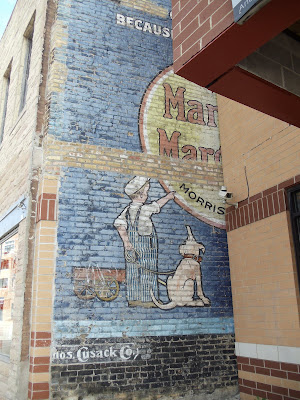
The condo building next to it was just built in the last few years, as the Google street view shows it still under construction. So this ad was probably covered for about 70-80 years by another building, which is why it's so vibrant. As it's on the south side of the building, hopefully the elements won't ruin it too fast.
While I'm not sure what product is being advertised--maybe Marlboro Cigarettes by Philip Morris?--the painter was the Thomas Cusack Company of Chicago, founded by Thos. Cusack in the 1870s. (Update: The product is actually Marigold Margarine. Thanks to Joel B. for the correction.)
Information on Ghost Ads and Ghost Signs from Wikipedia:
Ghost sign is a term for old hand-painted advertising signage that has been preserved on a building for an extended period of time, whether by actively keeping it or choosing not to destroy it.
Preservation
They are found across the world with America, the United Kingdom, France and Canada having many surviving examples. Ghost signs are also called fading ads and brickads. In many cases these are advertisements painted on brick that remained over time.
Many ghost signs still visible are from the 1890s to 1960s. Such signs were most commonly used in the decades before the Great Depression.
As signage advertising formats changed, less durable signs appeared in the later 20th century, and ghost signs from that era are less common.
In a New York Times article on ghost signs, Kathleen Hulser of the New York Historical Society, said, "[The signs] evoke the exuberant period of American capitalism. Consumer cultures were really getting going and there weren't many rules yet, no landmarks preservation commission or organized community saying: 'Isn't this awful? There's a picture of a man chewing tobacco on the corner of my street.'"
While driving up Lincoln towards Evanston the other day, we came across this amazing ad just south of Carmen.

The condo building next to it was just built in the last few years, as the Google street view shows it still under construction. So this ad was probably covered for about 70-80 years by another building, which is why it's so vibrant. As it's on the south side of the building, hopefully the elements won't ruin it too fast.
While I'm not sure what product is being advertised--maybe Marlboro Cigarettes by Philip Morris?--the painter was the Thomas Cusack Company of Chicago, founded by Thos. Cusack in the 1870s. (Update: The product is actually Marigold Margarine. Thanks to Joel B. for the correction.)
Information on Ghost Ads and Ghost Signs from Wikipedia:
Ghost sign is a term for old hand-painted advertising signage that has been preserved on a building for an extended period of time, whether by actively keeping it or choosing not to destroy it.
Preservation
They are found across the world with America, the United Kingdom, France and Canada having many surviving examples. Ghost signs are also called fading ads and brickads. In many cases these are advertisements painted on brick that remained over time.
Many ghost signs still visible are from the 1890s to 1960s. Such signs were most commonly used in the decades before the Great Depression.
As signage advertising formats changed, less durable signs appeared in the later 20th century, and ghost signs from that era are less common.
In a New York Times article on ghost signs, Kathleen Hulser of the New York Historical Society, said, "[The signs] evoke the exuberant period of American capitalism. Consumer cultures were really getting going and there weren't many rules yet, no landmarks preservation commission or organized community saying: 'Isn't this awful? There's a picture of a man chewing tobacco on the corner of my street.'"
August 21, 2010

Rogers Park Train Depot, a Hundred Years Ago
We occasionally feature images from Uptown's surrounding neighborhoods, and this is one worthy of checking out. It's a train depot in Rogers Park, roughly a hundred years ago.

Currently available for sale here: Rogers Park Train Station
Currently available for sale here: Rogers Park Train Station
August 20, 2010
Fire at the Chatter Box / Granada Theatre, Chicago, 1955
Crowd in front of the Granada Theater soon after they were evacuated when a 2-11 alarm was sounded. The Chatter Box next to the theater was destroyed by fire on April 12 1955. The theatre stood until 1990.

The Granada Theatre was a movie palace every bit as grand as the Uptown Theatre; it was located at 6427 N. Sheridan. Read more about its history (and demise) here: Granada Theatre.
Both the original image and high-resolution copies are for sale here: Granada Theatre Chicago
The Granada Theatre was a movie palace every bit as grand as the Uptown Theatre; it was located at 6427 N. Sheridan. Read more about its history (and demise) here: Granada Theatre.
Both the original image and high-resolution copies are for sale here: Granada Theatre Chicago
Hillbillies in Chicago, 1958
An excerpt from Hillbillies in Chicago:
Chicago's toughest integration problems happen to involve whites, hillbillies, and not Negroes.
Albert N. Votaw executive director of the Uptown Chicago Commission, writes in Harper's Magazine (February, 1958) on "The Hillbillies Invade Chicago." He says:
A pathetic though bumptious minority of 70,000 newcomers among Chicago's motley population of four million is disturbing the city's peace these days and incidentally proving to everybody who will listen that integration problems often have nothing to do with race, language, or creed. These are Chicago's share of the hundreds of thousands of Southern Hillbillies who have been imported during and since World War II to offset labor shortages in the industrial centers of Ohio, Indiana, Michigan, and Illinois.
'In my opinion they are worse than the colored,' said a police captain. 'They are vicious and knife-happy. They are involved in 75 percent of our arrests in this district.'
'I can't say this publically, but you'll never improve the neighborhood until you get rid of them,' commented a municipal court judge.
Read complete article here.
Chicago's toughest integration problems happen to involve whites, hillbillies, and not Negroes.
Albert N. Votaw executive director of the Uptown Chicago Commission, writes in Harper's Magazine (February, 1958) on "The Hillbillies Invade Chicago." He says:
A pathetic though bumptious minority of 70,000 newcomers among Chicago's motley population of four million is disturbing the city's peace these days and incidentally proving to everybody who will listen that integration problems often have nothing to do with race, language, or creed. These are Chicago's share of the hundreds of thousands of Southern Hillbillies who have been imported during and since World War II to offset labor shortages in the industrial centers of Ohio, Indiana, Michigan, and Illinois.
'In my opinion they are worse than the colored,' said a police captain. 'They are vicious and knife-happy. They are involved in 75 percent of our arrests in this district.'
'I can't say this publically, but you'll never improve the neighborhood until you get rid of them,' commented a municipal court judge.
Read complete article here.
August 19, 2010
New Facade Element on Chelsea Hotel, a.k.a. Friendly Towers

Uptown Update is reporting that the historic cast iron canopy removed from the Friendly Towers on Wilson has finally been replaced with a new (somewhat less impressive) architectural element. Visit their blog and check it out.
The image here is an early postcard of when the Friendly Towers was the Chelsea Hotel. The back reads: "Phone Longbeach 3000, 260 Rooms each with Bath. Rates $50, $60, $70 and $80 per month. Residential and Transient Room with Bath $2.00 and up."
Backstage Nightclub, 935 Wilson, Uptown Chicago, 1951
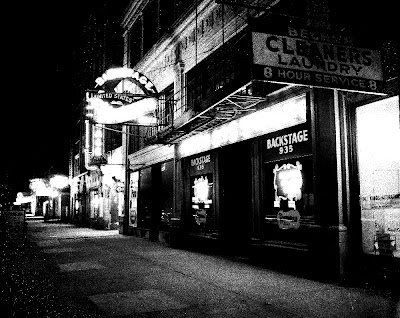
To see a matchbook cover we previously posted of this location, go to 935 Wilson.
The original and high-res prints of this photo are available at time of writing from eBay
Montrose Harbor, 1959, Uptown Chicago
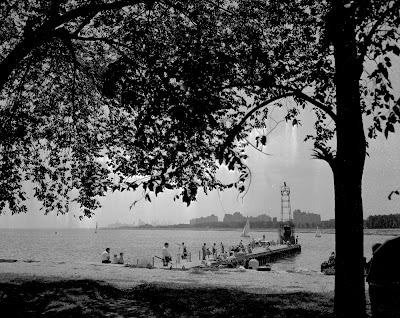
Montrose Harbor, circa 1959. (Original image available here: Montrose Harbor Chicago
August 18, 2010
Operation Inland Sea at Montrose Harbor, 1959.

What a crowd! You can spot the Edgewater Beach Hotel at the far right.
Original image, as well as high-quality reprints available from here: Montrose Harbor, 1959
From the seller's description: Operation Inland Sea Montrose 1959. Huge crowds turn out to watch the Inland Sea Opening Ceremonies. Operation Inland Seas (or Sea) was a United States Navy operation to celebrate the completion of the Saint Lawrence Seaway in 1959. Task Force 47 (TF 47), a 28-ship detachment of the U.S. Atlantic Fleet under the command of Rear Admiral Edmund B. Taylor, sailed up the Saint Lawrence River to participate in the official opening of the Seaway by Queen Elizabeth II of Canada and U.S. President Dwight D. Eisenhower on June 26, 1959. Thereafter, the ships visited ports throughout the Great Lakes, sometimes escorting Queen Elizabeth aboard HMY Britannia. June 26, 1959
Fishing at Montrose Harbor, 1955

Fishing at Montrose Harbor, 1955. Original image available from here: Fishing at Montrose Harbor, 1955
Nike Missile C-03 Montrose Harbor/Belmont Harbor Chicago
Nike Missile Site C-03
Chicago – Gary Area
Montrose Harbor/ Belmont Harbor
Oct 1955 – June 1965
It's hard to imagine now, but during the Cold War, Chicago's lakefront was lined with anti-aircraft missiles. Ed's Nike Missile Web site has many photographs of the Nike missiles, including this amazing then and now view. Definitely go to Ed's site to surf his collection of facts and photos.

* "Chicago has become the best defended city in the Middle West against enemy air-to-ground attacks."
—Chicago Sun Times
"… Nike probably would shoot down not only enemy bombers but any bomb armed rockets the bombers might drop."
—Milwaukee Journal
"The structures contrast grimly with the pastoral scenery extending toward the horizon… It is a contrast of grim necessity - the grimmest of our civilization."
—Chicago Daily Tribune
"Chicago is loaded for bear — even the Russian bear if the Reds should ever dare send their bombers to attack the city." "A ring of sword-like guided missiles called the Nike - revealed for the first time today - stands ready to send sudden death belting into the sky to meet any enemy head on." "They are inescapable by any air maneuver now known to aviation…" "The thing you ought to remember is that the Nike's presence hereabouts should enable you to sleep a lot more soundly." "They make nice neighbors."
—Chicago American
Project Nike was a U.S. Army project, proposed in May 1945 by Bell Laboratories, to develop a line-of-sight anti-aircraft missile system. The project delivered the United States' first operational anti-aircraft missile system during 1953, the Nike Ajax. A great number of the technologies and rocket systems used for developing the Nike Ajax were re-used for a number of functions, many of which were given the "Nike" name (after Nike, the goddess of victory from Greek mythology). The missile's first-stage solid rocket booster became the basis for many types of rocket including the Nike Hercules missile and NASA's Nike Smoke rocket, used for upper-atmosphere research.
Soviet development of ICBMs decreased the value of the Nike air defense system. Beginning around 1965, the number of Nike batteries was reduced. Thule air defense was reduced during 1965 and SAC air base defense during 1966, reducing the number of batteries to 112. Budgetary cuts reduced that number to 87 in 1968, and 82 in 1969.
Nike Hercules was included in SALT I discussions as an ABM. Following the treaty signed during 1972, and further budget reduction, almost all Nike sites in the continental United States were deactivated by April, 1974. Some units remained active until the later part of that decade in a coast air defense role.
Leftover traces of the approximately 300 Nike missile bases can still be seen around cities across the country. As the sites were decommissioned they were first offered to Federal agencies. Many were already located on Army National Guard bases who continued to use the property. Others were offered to state and local governments while others were sold to school districts. The left-overs were offered to private individuals. Thus, many Nike sites are now municipal yards, communications and FAA facilities (the IFC areas), probation camps, and even renovated for use as Airsoft gaming and MilSim training complexes. Several were completely obliterated and turned into parks. Some are now private residences. Only a few remain intact and preserve the history of the Nike project.
* Info on Nike missiles from Wikipedia. For a list of Nike Missile sites, see Nike Missile Sites. Collected newspaper quotes from Mike Epperson's site. Visit it for additional photos of lakefront nuclear missiles.
Additional resources:
Rings of Supersonic Steel: Air Defenses of the United States Army 1950-1974 - An Introductory History and Site Guide
US Strategic and Defensive Missile Systems 1950-2004
Last Missile Site: An Operational and Physical History of Nike Site SF-88, Fort Barry, California
NIKE Missile 1950s And 1960s (DVD)
(DVD)
1959 Bell Telephone System Nike-Hercules Missile Print Ad
1957 AMF Defense Nike Lacrosse Hawk 18 Missiles Print Ad (42552)
Chicago Nike Missile Sites

Chicago – Gary Area
Montrose Harbor/ Belmont Harbor
Oct 1955 – June 1965
It's hard to imagine now, but during the Cold War, Chicago's lakefront was lined with anti-aircraft missiles. Ed's Nike Missile Web site has many photographs of the Nike missiles, including this amazing then and now view. Definitely go to Ed's site to surf his collection of facts and photos.

* "Chicago has become the best defended city in the Middle West against enemy air-to-ground attacks."
—Chicago Sun Times
"… Nike probably would shoot down not only enemy bombers but any bomb armed rockets the bombers might drop."
—Milwaukee Journal
"The structures contrast grimly with the pastoral scenery extending toward the horizon… It is a contrast of grim necessity - the grimmest of our civilization."
—Chicago Daily Tribune
"Chicago is loaded for bear — even the Russian bear if the Reds should ever dare send their bombers to attack the city." "A ring of sword-like guided missiles called the Nike - revealed for the first time today - stands ready to send sudden death belting into the sky to meet any enemy head on." "They are inescapable by any air maneuver now known to aviation…" "The thing you ought to remember is that the Nike's presence hereabouts should enable you to sleep a lot more soundly." "They make nice neighbors."
—Chicago American
Project Nike was a U.S. Army project, proposed in May 1945 by Bell Laboratories, to develop a line-of-sight anti-aircraft missile system. The project delivered the United States' first operational anti-aircraft missile system during 1953, the Nike Ajax. A great number of the technologies and rocket systems used for developing the Nike Ajax were re-used for a number of functions, many of which were given the "Nike" name (after Nike, the goddess of victory from Greek mythology). The missile's first-stage solid rocket booster became the basis for many types of rocket including the Nike Hercules missile and NASA's Nike Smoke rocket, used for upper-atmosphere research.
Soviet development of ICBMs decreased the value of the Nike air defense system. Beginning around 1965, the number of Nike batteries was reduced. Thule air defense was reduced during 1965 and SAC air base defense during 1966, reducing the number of batteries to 112. Budgetary cuts reduced that number to 87 in 1968, and 82 in 1969.
Nike Hercules was included in SALT I discussions as an ABM. Following the treaty signed during 1972, and further budget reduction, almost all Nike sites in the continental United States were deactivated by April, 1974. Some units remained active until the later part of that decade in a coast air defense role.
Leftover traces of the approximately 300 Nike missile bases can still be seen around cities across the country. As the sites were decommissioned they were first offered to Federal agencies. Many were already located on Army National Guard bases who continued to use the property. Others were offered to state and local governments while others were sold to school districts. The left-overs were offered to private individuals. Thus, many Nike sites are now municipal yards, communications and FAA facilities (the IFC areas), probation camps, and even renovated for use as Airsoft gaming and MilSim training complexes. Several were completely obliterated and turned into parks. Some are now private residences. Only a few remain intact and preserve the history of the Nike project.
* Info on Nike missiles from Wikipedia. For a list of Nike Missile sites, see Nike Missile Sites. Collected newspaper quotes from Mike Epperson's site. Visit it for additional photos of lakefront nuclear missiles.
Additional resources:
Rings of Supersonic Steel: Air Defenses of the United States Army 1950-1974 - An Introductory History and Site Guide
US Strategic and Defensive Missile Systems 1950-2004
Last Missile Site: An Operational and Physical History of Nike Site SF-88, Fort Barry, California
NIKE Missile 1950s And 1960s
(DVD)1959 Bell Telephone System Nike-Hercules Missile Print Ad
1957 AMF Defense Nike Lacrosse Hawk 18 Missiles Print Ad (42552)
Chicago Nike Missile Sites
Happy Birthday, Uptown Theatre!
From the Uptown Adviser, reprinted with permission. For more information on the Uptown Theatre, go to Friends of the Uptown and visit the Uptown Theatre Fan Page on Facebook.
85 Candles for the UPTOWN
Today is the 85th anniversary of the UPTOWN THEATRE's opening to the public at 4814-4816 N. Broadway, Broadway and Lawrence in Chicago. Closed since 1981, this privately owned Chicago landmark is protected from further damage but needs tens of millions of dollars to be renovated and reused.
Largely unaltered from its Aug. 18, 1925, opening, the Spanish-Baroque themed UPTOWN is an American movie palace that features a monumental terra cotta facade, a grande lobby, a middle lobby, an exit lobby, a 4,300-plus seat auditorium with a mezzanine and balcony, a full working stage, an orchestra lift, two massive organ chambers (now empty), four floors of dressing rooms, an office suite, a radio broadcasting room, a deluxe playroom for children, men's and women's lounges, a decorative fountain and many staff areas.
It is interesting to note the reviews of the preview and opening from Aug. 17 and 18, 1925. Contemporary reviews are so revealing. The Jazz Age Chicago web site has done a great job of compiling this information.
http://chicago.urban-history.org/ven/ths/uptown_t.shtml
Here's a brief history written with the late historian and designer Joe DuciBella, who worked there for a time for B&K.
http://www.uptowntheatre.com/Pages/history.html
Compass Rose Cultural Crossroads has found interesting artifacts when we thought they had all been scooped up and tucked away by previous generations!
http://www.compassrose.org/uptowntheatre/history.html
85 Candles for the UPTOWN
Today is the 85th anniversary of the UPTOWN THEATRE's opening to the public at 4814-4816 N. Broadway, Broadway and Lawrence in Chicago. Closed since 1981, this privately owned Chicago landmark is protected from further damage but needs tens of millions of dollars to be renovated and reused.
Largely unaltered from its Aug. 18, 1925, opening, the Spanish-Baroque themed UPTOWN is an American movie palace that features a monumental terra cotta facade, a grande lobby, a middle lobby, an exit lobby, a 4,300-plus seat auditorium with a mezzanine and balcony, a full working stage, an orchestra lift, two massive organ chambers (now empty), four floors of dressing rooms, an office suite, a radio broadcasting room, a deluxe playroom for children, men's and women's lounges, a decorative fountain and many staff areas.
It is interesting to note the reviews of the preview and opening from Aug. 17 and 18, 1925. Contemporary reviews are so revealing. The Jazz Age Chicago web site has done a great job of compiling this information.
http://chicago.urban-history.org/ven/ths/uptown_t.shtml
Here's a brief history written with the late historian and designer Joe DuciBella, who worked there for a time for B&K.
http://www.uptowntheatre.com/Pages/history.html
Compass Rose Cultural Crossroads has found interesting artifacts when we thought they had all been scooped up and tucked away by previous generations!
http://www.compassrose.org/uptowntheatre/history.html
August 17, 2010
Inside Uptown Community Guide Now Available
 Filled with history, fun facts, and a directory of chamber members, this guide is sure to prove useful to residents and visitors all year round!
Request your copy today; e-mail the chamber at info(a)uptownbusinesspartners.com.
Visit Business Partners, The Chamber for Uptown
Subscribe to:
Posts (Atom)
LinkWithin

LinkWithin